
The biggest technology trends 2026 are being shaped by artificial intelligence, specialized chips, cloud infrastructure, and cybersecurity. Rather than developing separately, these technologies are increasingly connected: AI needs powerful chips and cloud systems, while those systems require stronger security as more businesses deploy intelligent software and autonomous agents.
For consumers and businesses, the important question is not simply which technology is newest. It is how these developments are changing computing costs, digital services, data protection, software development, and everyday devices. This guide examines the major technology trends shaping 2026 and explains why each one matters.
What Are the Biggest Technology Trends in 2026?
Technology in 2026 is moving from experimentation toward large-scale deployment.
Three areas stand out particularly strongly:
- AI chips and specialized computing
- Cloud and AI infrastructure
- Cybersecurity and digital security
Other important developments include AI agents, edge computing, AI-powered devices, software automation, and increasingly integrated digital ecosystems.
The common factor is infrastructure. Powerful AI applications cannot operate at scale without chips, data centers, networking, cloud platforms, and security systems.
Read More:Best PC Games 2026: New Games Worth Playing This Year
1. AI Chips Are Becoming More Important
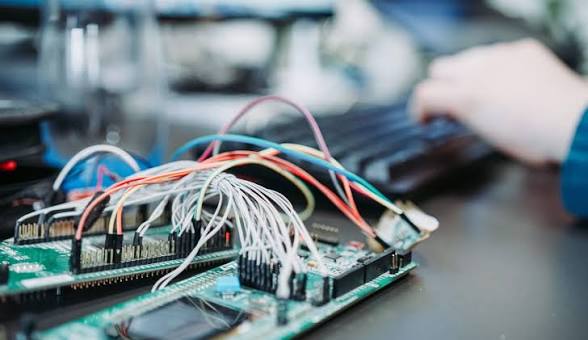
One of the biggest technology trends 2026 is the rapid expansion of specialized AI hardware.
Traditional CPUs remain important, but modern AI workloads increasingly rely on GPUs and other accelerators designed for parallel computing.
Companies are also developing specialized chips for particular AI workloads.
Why AI Chips Matter
AI models require enormous amounts of computation.
AI hardware influences:
- Model training speed
- AI inference speed
- Energy consumption
- Data-center costs
- Application latency
- Overall AI scalability
Nvidia’s latest results illustrate the scale of this demand. The company reported $96.22 billion in quarterly revenue, including $89 billion from its data-center business, while forecasting approximately $108 billion in revenue for the following quarter.
These numbers are important because they show that AI computing is no longer a small experimental market.
The Shift From General-Purpose to Specialized Hardware
The industry is increasingly exploring different types of accelerators for different workloads.
For example:
| Hardware | Typical strength |
|---|---|
| CPU | General-purpose computing |
| GPU | Parallel workloads and AI |
| NPU | AI workloads on personal devices |
| AI accelerator | Specialized machine-learning workloads |
| HBM | High-speed memory for demanding AI systems |
The goal is not simply to build the biggest chip. It is to build computing systems that deliver useful AI performance efficiently.
2. AI Inference Is Becoming a Major Hardware Challenge
Training an AI model receives considerable attention, but inference is becoming equally important.
Inference is the process of using a trained model to generate an answer, prediction, image, or other output.
As millions of users interact with AI systems, companies need enormous amounts of inference capacity.
This is especially important for AI agents that perform multiple steps on behalf of users.
Low latency becomes critical when an AI system needs to:
- Understand a request.
- Access information.
- Use a software tool.
- Make a decision.
- Perform an action.
- Return the result.
Nvidia has expanded its focus on inference hardware, while its commercialization of technology from Groq is aimed at improving token generation and reducing latency for AI-agent workloads.
This means AI chip competition is increasingly about speed, efficiency, and responsiveness, not just training performance.
3. Cloud Computing Is Becoming AI Infrastructure
Cloud computing remains one of the foundations of modern technology.
But in 2026, cloud infrastructure is increasingly being redesigned around AI.
Major cloud providers need to support:
- AI model training
- AI inference
- Enterprise applications
- Data analytics
- AI agents
- High-performance computing
- Large-scale storage
This makes cloud infrastructure more than a place to host websites and applications.
It is becoming the underlying computing layer for artificial intelligence.
AI and Cloud Are Closely Connected
A simple way to understand the relationship is:
AI models → require computing → computing requires infrastructure → cloud provides scalable infrastructure
This is why investment in AI chips and investment in cloud data centers are closely connected.
4. Data Centers Are Becoming Strategic Technology Assets
Data centers are one of the less visible but most important technology trends of 2026.
AI workloads require enormous amounts of computing equipment, electricity, cooling, networking, and storage.
As AI adoption grows, companies need more specialized data-center capacity.
This creates challenges involving:
- Power availability
- Cooling
- Land
- Networking
- Hardware supply
- Energy efficiency
- Construction time
The growth of AI therefore has consequences beyond the software industry.
It is increasingly connected to energy infrastructure and physical construction.
5. Cloud Computing Is Moving Toward More Specialized Architectures
Cloud providers are not simply adding more conventional servers.
They are increasingly designing infrastructure around specific workloads.
This can include:
- AI accelerators
- High-speed networking
- Specialized storage
- Confidential computing
- Edge infrastructure
- AI-optimized data centers
The objective is to improve performance while controlling the cost of running increasingly demanding workloads.
This shift is particularly important for businesses because cloud costs can become significant when AI applications process large amounts of data or generate millions of inference requests.
6. AI Agents Are Changing How Software Works
Another major technology trend is the rise of AI agents.
A traditional chatbot generally responds to a user’s request.
An AI agent can potentially perform multiple actions to accomplish a broader goal.
For example, instead of asking an assistant:
“What are the best flights?”
a future agent could potentially research options, compare information, interact with approved services, and help complete the task.
The important difference is action.
AI is increasingly moving from:
Generate an answer
to:
Understand → plan → use tools → act → evaluate
This creates significant opportunities for businesses, but it also creates new security and governance challenges.
7. Cybersecurity Is Becoming an AI Problem
Cybersecurity is another defining technology trend in 2026.
AI can help defenders analyze threats, identify suspicious behavior, and automate security operations.
But AI can also increase the capabilities available to attackers.
The Cloud Security Alliance’s 2026 cloud-threat research identifies AI-enhanced attacks and AI system compromise among major cloud-security concerns.
AI Creates a Two-Sided Security Problem
AI can act as:
A defensive tool
- Threat detection
- Vulnerability analysis
- Security monitoring
- Incident response
- Security automation
And potentially as:
An attack enabler
- Faster reconnaissance
- Automated exploitation
- Social engineering assistance
- Malware development support
- Large-scale attack automation
This dual-use nature makes AI security particularly difficult.
8. AI Cyberattacks Are Becoming a Major Concern
The cybersecurity industry is increasingly focused on AI-assisted attacks.
More than 100 major technology and financial companies recently called for stronger defenses against AI-driven cyberattacks. The coalition included companies such as OpenAI, Microsoft, Alphabet, Amazon, and IBM.
The message is significant: AI security is no longer only a specialized concern for cybersecurity teams.
It is becoming a strategic issue for governments, cloud providers, software companies, and businesses.
9. Identity and Access Management Are Becoming More Important
As organizations use AI agents and automated software, traditional usernames and passwords become only one part of the security problem.
Organizations increasingly need to control:
- Which AI agents can access data
- Which applications an agent can use
- What actions an agent can perform
- Which users can approve those actions
- How activity is monitored
This makes identity management particularly important.
A human employee might have permission to access a financial system, but an AI agent operating on that employee’s behalf should not automatically receive unlimited access.
This principle is becoming central to secure AI deployment.
10. Cloud Security Is Moving Beyond Traditional Infrastructure
Cloud security used to focus heavily on servers, networks, applications, and access controls.
AI is adding another layer.
Security teams now have to consider:
- AI models
- Training data
- Prompts
- AI agents
- Model permissions
- Connected tools
- Data leakage
- Supply-chain risks
The Cloud Security Alliance’s 2026 research highlights identity, AI, software supply chains, and interconnected cloud ecosystems as major security concerns.
This means organizations increasingly need security strategies that cover both traditional cloud systems and AI workloads.
11. Edge Computing Is Becoming More Relevant
Cloud computing is powerful, but sending every piece of information to a remote data center is not always ideal.
Edge computing moves some processing closer to where data is generated.
This can be useful for:
- Smart devices
- Industrial systems
- Autonomous machines
- Retail technology
- Connected vehicles
- Real-time analytics
The rise of AI agents and machine-generated traffic is also increasing the importance of latency and distributed infrastructure. Recent analysis of internet traffic trends suggests AI-generated traffic is growing rapidly and creating new infrastructure requirements.
Cloud vs Edge Computing
| Cloud | Edge |
|---|---|
| Centralized infrastructure | Processing closer to users/devices |
| Excellent for large-scale workloads | Useful for low-latency workloads |
| Large computing resources | More localized processing |
| Internet connection often important | Can reduce dependence on distant servers |
| Ideal for centralized AI services | Useful for real-time AI applications |
The two approaches are not necessarily competitors. Many modern systems will use both.
12. AI Is Moving Onto Personal Devices
AI is also becoming more common directly inside smartphones and computers.
Modern processors increasingly include dedicated AI capabilities, allowing some workloads to run locally.
This can provide potential benefits such as:
- Lower latency
- Reduced cloud dependence
- Better privacy for certain workloads
- Offline functionality
- Lower network usage
The result is a hybrid model:
Device AI + Cloud AI
Some tasks can run locally, while more demanding operations can be handled in the cloud.
13. Technology Companies Are Focusing More on Efficiency
One of the most important changes in 2026 is that raw performance is no longer the only goal.
Efficiency matters.
Businesses increasingly ask:
- How much does each AI request cost?
- How much electricity does the system consume?
- How quickly can it respond?
- How much infrastructure does it require?
- Can some workloads run locally?
- Can smaller models achieve the same result?
This is why specialized chips, smaller models, inference optimization, and efficient data centers are receiving so much attention.
14. AI Governance Is Becoming Part of Technology Strategy
As AI becomes more deeply integrated into business operations, companies need policies covering how AI systems are used.
AI governance can involve:
- Data protection
- Model evaluation
- Access controls
- Human oversight
- Risk management
- Compliance
- Monitoring
- Transparency
This is especially important when AI agents can interact with business systems.
A company may have excellent AI performance but still face serious risks if it cannot control what its AI systems can access or do.
15. Software Development Is Being Reshaped by AI
AI coding tools are changing how developers write and maintain software.
Developers can use AI to help with:
- Code generation
- Debugging
- Documentation
- Testing
- Refactoring
- Code explanation
- Software research
However, AI-generated code still requires review.
Developers need to check for:
- Security vulnerabilities
- Incorrect logic
- Dependency risks
- Performance problems
- Licensing concerns
- Maintainability
The trend is therefore not simply “AI replaces programmers.”
Instead, software development is increasingly becoming a collaboration between humans and AI-powered tools.
16. Semiconductor Supply Chains Remain Critical
The growth of AI is also changing the semiconductor industry.
AI computing requires processors, memory, networking hardware, and advanced packaging.
This makes semiconductor supply chains strategically important.
Deloitte’s 2026 semiconductor outlook notes that chip sales continue to rise while the industry is also paying greater attention to demand risks, integrated system architecture, and balancing investment.
This means the future of AI depends partly on whether the hardware industry can continue expanding efficiently.
17. The Most Important Technology Trend Is Convergence
Perhaps the biggest trend of all is that technologies are becoming increasingly interconnected.
Consider a modern AI application:
AI model
↓
AI accelerator
↓
Cloud infrastructure
↓
Data and storage
↓
Network
↓
Security and identity
↓
Application
↓
User
A problem at any layer can affect the complete system.
That is why businesses increasingly need to think about technology as an ecosystem rather than a collection of independent products.
How These Technology Trends Affect Businesses
For businesses, the biggest changes are likely to involve productivity, infrastructure, security, and skills.
Businesses should consider:
- Which AI workloads actually create value?
- Which data can AI systems access?
- How should AI agents be controlled?
- Which workloads belong in the cloud?
- Which workloads should run at the edge?
- How can AI infrastructure costs be controlled?
- What new cybersecurity risks are being introduced?
The goal should not be adopting every new technology.
The goal should be using technology where it solves a real problem.
How These Trends Affect Everyday Users
Consumers may experience these trends through products rather than infrastructure.
Examples include:
- AI features in smartphones
- AI-powered laptops
- Smarter search
- AI assistants
- More personalized applications
- Faster cloud services
- Better security tools
- Connected devices
Users may not see an AI accelerator or data center directly, but these technologies increasingly determine what their devices and applications can do.
Technology Trends to Watch for the Rest of 2026
Several areas deserve particular attention.
AI Chips
Watch for new accelerators, custom chips, improved inference hardware, and more efficient computing systems.
AI Agents
Pay attention to whether agents can reliably complete useful multi-step tasks rather than simply generating text.
Cloud Infrastructure
Watch how cloud companies optimize infrastructure for AI workloads and manage the costs associated with enormous computing demand.
Cybersecurity
Expect continued investment in AI-powered security alongside stronger defenses against AI-enabled attacks.
Edge AI
More processing may move onto devices and closer to users when latency, privacy, or connectivity makes local computing attractive.
AI Governance
Organizations will increasingly need practical rules for deploying AI safely and responsibly.
How to Choose Which Technology Trends Matter to You
You do not need to follow every technology announcement.
Use three questions:
1. Does it solve a real problem?
A technology is more valuable when it provides a measurable improvement.
2. Is it actually available?
Distinguish between a research demonstration, product announcement, beta feature, and widely available technology.
3. What are the trade-offs?
Consider:
- Cost
- Privacy
- Security
- Reliability
- Performance
- Compatibility
This approach helps separate genuine technological progress from marketing hype.
Frequently Asked Questions
What are the biggest technology trends in 2026?
The major trends include AI chips, AI agents, cloud and data-center infrastructure, cybersecurity, edge computing, AI-powered devices, software automation, and AI governance.
Why are AI chips important in 2026?
AI chips provide specialized computing power for training and running AI models. Increasing demand for AI is driving investment in GPUs, accelerators, networking, memory, and custom silicon. Nvidia’s latest results demonstrate the scale of the current AI infrastructure market.
How is cloud computing changing because of AI?
Cloud platforms are increasingly being optimized for AI workloads. Providers need specialized processors, high-speed networking, storage, and infrastructure capable of supporting both AI training and inference.
Is AI making cybersecurity better or worse?
Both. AI can help defenders detect and respond to threats, but it can also increase attackers’ capabilities. Recent industry research and warnings emphasize AI-enhanced attacks and the need for stronger security controls.
What is an AI agent?
An AI agent is a system designed to perform tasks using reasoning, tools, and actions rather than only producing a response. Agentic systems can potentially complete multi-step workflows with less direct human intervention.
What is edge computing?
Edge computing processes data closer to where it is generated instead of sending everything to a distant cloud data center. It can be useful when low latency, connectivity, or local processing is important.
Will AI replace traditional cloud computing?
No. AI is increasing demand for cloud infrastructure rather than eliminating it. At the same time, some AI workloads may increasingly run locally on devices or at the edge.
Conclusion
The Biggest Technology Trends 2026 are centered on a connected ecosystem of AI chips, cloud infrastructure, cybersecurity, AI agents, and edge computing. AI is driving demand for specialized hardware and data centers, while the growing ability of AI systems to access tools and information is making security and governance increasingly important.

1 Comment
Pingback: What's New in Technology This Week? Key Updates Explained