

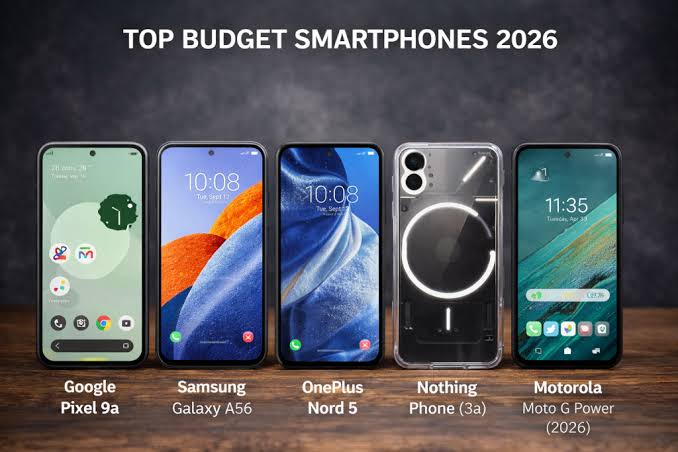
Buying a cheap phone in 2026 no longer means settling for a slow processor, poor display, or a camera that struggles with everyday photos. The best budget smartphones now offer 5G, high-refresh-rate screens, large batteries, capable cameras, and much better software support than affordable phones from just a few years ago.
Some budget phones look impressive on a specification sheet but cut corners with cameras, software updates, charging, or carrier compatibility. Others cost a little more but deliver a much better experience over several years.
For this guide, the budget category stretches to roughly $500, although the strongest value is concentrated between $250 and $400. Based on current 2026 pricing, availability, hardware, software support, and overall value, these are the budget smartphones worth considering right now.
Best Budget Smartphones in 2026
| Phone | Starting price | Chipset | Display | Battery | Camera | Software support |
|---|---|---|---|---|---|---|
| Google Pixel 10a | $499 | Tensor G4 | 6.3″ 120Hz pOLED | 5,100mAh | 48MP + 13MP | 7 years |
| Samsung Galaxy A36 5G | $399.99 | Snapdragon 6 Gen 3 | 6.7″ 120Hz AMOLED | 5,000mAh | 50MP OIS + 8MP + 5MP | 6 years |
| Nothing Phone (4a) | Around $349–$429 | Snapdragon 7s Gen 4 | 6.78″ 120Hz AMOLED | 5,080mAh | 50MP + 50MP telephoto + 8MP | 3 OS + 6 security |
| Motorola Moto G Power 2026 | $299.99 | Dimensity 6300 | 6.8″ 120Hz LCD | 5,200mAh | 50MP OIS + 8MP | 2 OS + 3 security |
| Samsung Galaxy A26 5G | $299.99 | Exynos 1380 | 6.7″ 120Hz AMOLED | 5,000mAh | 50MP OIS + 8MP + 2MP | 6 years |
Prices shown are starting prices or typical launch pricing and can vary by retailer, region, storage configuration, and promotions.
Google Pixel 10a — Best Budget Phone Overall
The Google Pixel 10a is the easiest recommendation for buyers who want a balanced phone and intend to keep it for years.
It starts at $499 in the U.S., putting it at the top end of what most people would call a budget phone. However, its combination of camera quality, software, display, battery life, durability, and long-term updates makes the higher price easier to justify. Google lists a 6.3-inch 120Hz pOLED display, Tensor G4 processor, 5,100mAh battery, wireless charging, IP68 protection, and 128GB or 256GB storage.
The biggest reason to buy it is software longevity. Google promises seven years of operating-system and security updates, which is unusually strong for this price category.
The camera system is also one of the strongest reasons to choose the Pixel. Its 48MP main camera is paired with a 13MP ultrawide, while Google’s computational photography and AI editing tools help it produce consistently good results without requiring much manual work.
Best for: Camera quality, software updates, everyday use and long-term ownership.
Watch out for: The $499 starting price means it competes with more powerful phones, and the Tensor G4 is not the best choice if gaming performance is your top priority.
Read More: AI Agents Explained: What They Are and How They Actually Work
Samsung Galaxy A36 5G — Best Samsung Budget Phone
Samsung’s Galaxy A36 5G is one of the strongest all-round Android options below $400.
The phone launched at $399.99 in the U.S. and brings a large 6.7-inch Super AMOLED display with a 120Hz refresh rate. Samsung also equips it with a 5,000mAh battery and a 50MP main camera with optical image stabilization.
The display is particularly attractive at this price. AMOLED gives the A36 deeper blacks and stronger contrast than the LCD panels found on many cheaper phones, while 120Hz makes scrolling and animations noticeably smoother.
Samsung’s software commitment is another major advantage. The A36 series is covered by up to six years of operating-system and security updates, giving it a considerably longer useful life than many inexpensive Android alternatives.
The A36 is not designed to compete with expensive gaming phones, but it is a very dependable choice for messaging, social media, streaming, photography, browsing and general productivity.
Best for: Samsung fans, AMOLED displays, long-term ownership and balanced everyday use.
Watch out for: Performance is respectable rather than class-leading, and the U.S. Samsung store currently lists the 128GB unlocked model at $399.99 but shows it as out of stock at the time of research.
Nothing Phone (4a) — Best for Display, Design and Value
The Nothing Phone (4a) is one of the most interesting budget phones released in 2026 because it does not look or feel like a conventional inexpensive smartphone.
Its 6.78-inch AMOLED display runs at 120Hz and uses a 1.5K-class resolution. Under the hood is Qualcomm’s Snapdragon 7s Gen 4, giving it a stronger performance profile than many basic budget phones.
The camera hardware is unusually ambitious for the category. The phone combines a 50MP main camera with an 8MP ultrawide and a 50MP periscope telephoto camera with 3.5x optical zoom.
Battery capacity is 5,080mAh and wired charging reaches 50W, making it particularly appealing to users who dislike waiting around for their phone to recharge.
Nothing’s official pricing places the 8GB/128GB model at £349, while higher-storage configurations cost more. European retail pricing can vary considerably; for example, German retailers have recently listed the 128GB model below its €399 suggested price.
The main compromise is software longevity. Nothing promises three OS updates and six years of security updates, which is respectable but not as strong as Google’s seven-year commitment or Samsung’s six-year support on the A-series.
Best for: Display quality, design, fast charging and users who want more interesting hardware.
Watch out for: Availability and pricing vary by country, and software support is shorter than Google’s.
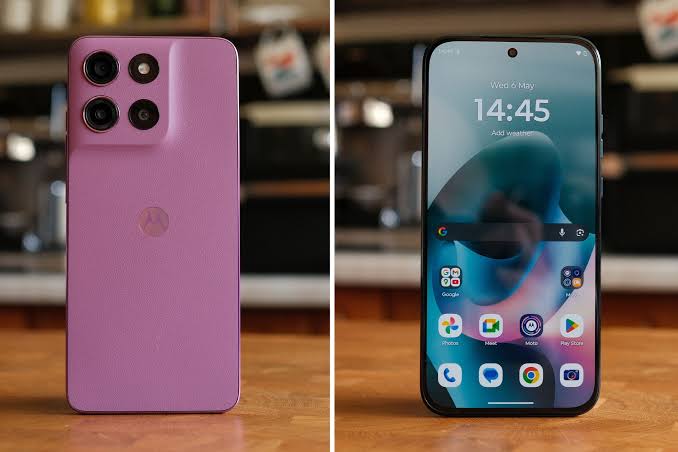
Motorola Moto G Power 2026 — Best for Battery Life and Durability
If battery life matters more than camera quality or premium performance, the Moto G Power 2026 deserves serious consideration.
Motorola launched it in the U.S. at $299.99, making it one of the more affordable mainstream 2026 smartphones. It combines a 6.8-inch FHD+ 120Hz display with a 5,200mAh battery, 30W charging, 5G connectivity and Android 16.
Its biggest advantage is durability. Motorola gives the phone IP68 and IP69 water and dust resistance, Gorilla Glass 7i, and MIL-STD-810H testing. That makes it particularly appealing for people who work outdoors, travel frequently, or simply want a phone that can tolerate more abuse.
The 50MP main camera includes optical image stabilization, while an 8MP ultrawide and 32MP selfie camera provide additional flexibility.
However, the Dimensity 6300 is an entry-level chipset. It handles everyday tasks well, but demanding games are not its strongest area. Recent testing also notes that the phone offers only two OS upgrades and three years of security updates.
Best for: Battery life, durability and buyers who want to stay around $300.
Watch out for: The LCD display is less premium than AMOLED, gaming performance is limited, and software support is comparatively short.
Samsung Galaxy A26 5G — Best Cheap Phone for Long-Term Value
The Galaxy A26 5G makes the most sense for buyers who want to spend around $300 without giving up long-term software support.
Samsung launched the A26 5G at $299.99 in the U.S. It features a 6.7-inch display, 120Hz refresh rate, 5,000mAh battery and a 50MP main camera with optical image stabilization.
The standout feature is again Samsung’s update policy. The A26 is part of the Galaxy A generation covered by up to six years of operating-system and security updates.
That matters because buying a phone for $300 is not necessarily a bargain if it becomes unsupported after two or three years. The A26 is a better example of budget value: reasonable hardware combined with a longer software lifespan.
It does not deliver the performance or camera processing of more expensive phones, but it is a sensible choice for calls, messaging, streaming, social media, navigation and everyday apps.
Best for: Affordable long-term ownership and Samsung’s software ecosystem.
Watch out for: Performance is behind the faster options in this list, especially for demanding games.
Which Budget Phone Should You Buy?
The right choice depends more on your priorities than on the highest specification.
For the best overall experience: Choose the Pixel 10a. It has the strongest combination of camera quality, clean software, useful AI features and seven years of support.
For photography: The Pixel 10a remains the safer choice for point-and-shoot photography, particularly when HDR processing, portraits and low-light photography matter.
For battery life: Choose the Moto G Power 2026 if you want a large battery and durable construction without spending $400 or more.
For display quality: The Nothing Phone (4a) and Galaxy A36 are stronger choices than LCD-based budget phones because of their 120Hz AMOLED panels.
For Samsung users: The Galaxy A36 5G is the better all-round choice, while the A26 makes more sense when keeping the price close to $300 is the priority.
For gaming: Avoid choosing purely by megapixel count or battery capacity. The Nothing Phone (4a)’s Snapdragon 7s Gen 4 gives it a stronger performance foundation than the entry-level Moto G Power, although neither should be confused with a dedicated gaming flagship.
What Counts as a Budget Phone in 2026?
The definition has shifted.
A phone under $300 is still genuine budget territory. Between $300 and $400, you can now find devices with AMOLED displays, 120Hz refresh rates, 5G and respectable cameras. Around $400–$500, the category begins overlapping with upper-mid-range phones and discounted previous-generation models.
That makes $500 a reasonable upper ceiling for a broad 2026 budget-phone buying guide.
However, don’t automatically spend the entire $500. A $300 phone that satisfies your needs can be a better purchase than a $500 model whose extra features you never use.
Unlocked vs. Carrier Phones
An unlocked phone is generally the safer choice if you want flexibility.
Unlocked models let you choose your carrier rather than tying the phone to a specific provider. Google’s Pixel 10a, for example, is sold unlocked through the Google Store.
Carrier deals can make expensive phones appear extremely cheap, but check the conditions carefully. A phone advertised as “$0 per month” may require a specific unlimited plan, a trade-in, or a multi-year installment agreement.
Before buying an imported budget phone, also check the supported 4G and 5G bands. A phone that works perfectly in one country may have incomplete network compatibility in another.
Don’t Ignore Software Updates
Software support is one of the most important differences between budget phones in 2026.
Samsung’s A26 and A36 offer up to six years of updates, while Google gives the Pixel 10a seven years. Nothing’s Phone (4a) provides three OS updates and six years of security updates. Motorola’s Moto G Power 2026 has a shorter two-OS-update and three-year security commitment.
For someone who replaces phones every two years, this may not matter much. For anyone planning to keep a phone for four or five years, it should be part of the buying decision.
When Is the Best Time to Buy?
The best time to buy is not always launch day.
New phones frequently cause older models to fall in price, while retailer promotions can temporarily make a higher-tier phone cheaper than its official MSRP. Trade-in promotions can also change the calculation significantly.
If you’re buying a phone close to $500, compare its current sale price against the next model above it. A $100 discount can turn a normally expensive phone into a much better value.
At the other end of the market, avoid buying an old model simply because its price looks attractive. Check its remaining software-support period, battery age and whether the manufacturer still sells it officially.
Are Budget Phones Worth Buying in 2026?
Yes. The gap between budget and flagship phones has narrowed considerably.
A good $300–$500 phone can now provide a 120Hz display, 5G, strong battery life, capable cameras, fast charging and years of software support. The biggest compromises tend to appear in areas such as advanced gaming performance, telephoto photography, premium materials and specialized flagship features.
The key is choosing the right compromise.
The Pixel 10a is the strongest choice for buyers who prioritize cameras and long-term software support. The Galaxy A36 5G offers a dependable Samsung experience with a great AMOLED display and long support. The Nothing Phone (4a) stands out for its screen, design, performance and charging. The Moto G Power 2026 is the practical battery-and-durability option, while the Galaxy A26 5G is one of the safer choices around $300 for long-term ownership.
For most people, spending a little more on one of these well-supported models is smarter than chasing the absolute cheapest phone available.
Conclusion
The best budget smartphone in 2026 isn’t necessarily the cheapest one. The real value comes from finding a phone that delivers dependable performance, a good display, capable cameras, strong battery life, and enough software support to remain useful for years.
For most buyers, the Google Pixel 10a is the strongest overall choice thanks to its camera performance and long update commitment. The Samsung Galaxy A36 5G is a great alternative for those who prefer Samsung’s ecosystem and AMOLED display, while the Nothing Phone (4a) stands out for design, display, charging, and performance. If battery life and durability matter most, the Moto G Power 2026 is worth considering, and the Galaxy A26 5G remains a sensible option for shoppers around the $300 mark.
Before buying, always check the current price, storage configuration, carrier compatibility, and software-support period. A slightly more expensive phone with longer support can ultimately offer better value than a cheaper model that needs replacing sooner.
In 2026, you don’t need to spend flagship money to get a genuinely good smartphone—you just need to choose the right budget phone for the way you use it.
