

Generative AI is a type of artificial intelligence that can create new content from instructions, examples, or other input. It can produce text, images, audio, video, software code, and other forms of digital content. Unlike traditional software that mainly follows predefined rules, generative AI learns patterns from large amounts of training data and uses those patterns to produce new outputs.
Today, generative AI is used in workplaces, education, software development, marketing, healthcare research, entertainment, customer service, and many other fields. Understanding how generative AI works makes it easier to use these systems effectively while recognizing their limitations.
What Is Generative AI?
Generative AI refers to AI systems designed to generate new content based on patterns learned during training.
A user might provide a prompt such as:
“Write a product description for a wireless keyboard.”
A generative AI system can analyze the instruction and produce a new response based on what it learned about language, structure, and related concepts.
Depending on the system, generative AI can create:
- Text
- Images
- Audio
- Music
- Video
- Computer code
- Presentations
- Summaries
- Synthetic data
Well-known generative AI systems include ChatGPT, Claude, Gemini, image-generation systems, coding assistants, and specialized creative tools.
Read More: Best Project Management Software 2026: Top Tools Compared
How Does Generative AI Work?
At a high level, generative AI works by learning statistical patterns from training data and using those patterns to generate an output.
The process can be simplified into several stages:
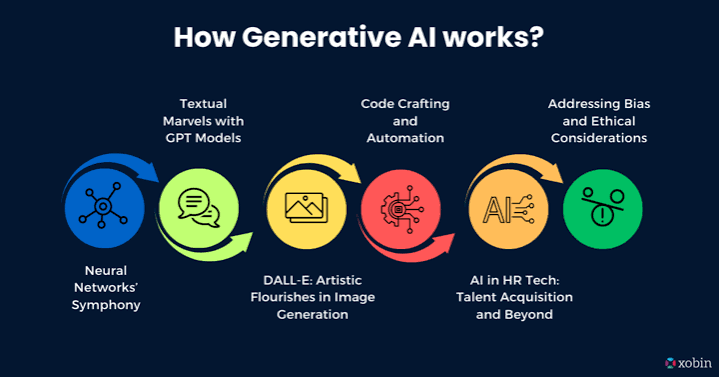
Training data → AI model → learned patterns → user prompt → generated output
The exact technology differs between systems, but this basic concept helps explain how modern generative AI works.
Step 1: Training the AI Model
Before a generative AI system can produce useful content, it needs to be trained.
Training involves exposing a model to large datasets.
Depending on the application, the training material may include:
- Text
- Images
- Audio
- Video
- Code
- Other structured or unstructured data
The model processes examples and learns patterns within them.
For a language model, those patterns can include relationships between words, phrases, concepts, syntax, and different forms of communication.
Step 2: The Model Learns Patterns
Generative AI does not simply store a giant collection of answers and retrieve one whenever someone asks a question.
Instead, machine-learning models learn numerical representations of patterns in their training data.
For language models, this involves learning relationships between tokens.
A token can represent a word, part of a word, punctuation, or another piece of text.
The model uses these representations to determine what output is likely to be appropriate given the input.
Step 3: The User Provides a Prompt
The user interacts with the model through an instruction called a prompt.
For example:
Prompt:
“Explain photosynthesis in simple language for a 10-year-old.”
The system processes the prompt and uses it as context for generating its response.
A more detailed prompt can specify:
- Audience
- Tone
- Format
- Length
- Required information
- Examples
- Restrictions
This is why prompt quality can have a significant effect on the usefulness of an AI response.
Step 4: The Model Generates an Output
For text generation, the model predicts tokens that are appropriate in the given context.
It generates the response progressively rather than writing the entire answer simultaneously.
A simplified example looks like this:
Input: “The capital of France is…”
Likely continuation: “Paris”
Real generative AI systems are considerably more sophisticated than this example. They use large neural networks and complex calculations to process context and generate outputs.
What Technology Powers Generative AI?
Modern generative AI relies on several important technologies.
Machine Learning
Machine learning allows systems to learn patterns from data instead of requiring developers to manually program every possible response.
Neural Networks
Neural networks are computational models inspired loosely by the way biological nervous systems process information.
Modern generative AI models often contain very large numbers of learned parameters.
Transformers
The Transformer architecture became particularly important for modern language models.
Transformers use mechanisms such as attention to determine relationships between different parts of an input.
This helps models process context and understand how words or tokens relate to one another.
Large Language Models
A large language model (LLM) is a generative AI model designed primarily to process and generate language.
ChatGPT, Claude, and Gemini are examples of AI assistants built around advanced generative models.
What Is Multimodal Generative AI?
Generative AI is no longer limited to text.
Multimodal AI can work with multiple types of information, such as:
- Text
- Images
- Audio
- Video
- Code
For example, a multimodal AI system could receive an image and answer questions about it.
Another system might accept a written description and generate an image.
This expands generative AI from a text-generation technology into a broader interface for interacting with digital information.
What Can Generative AI Create?
Generative AI can create many types of content.
Text
AI can generate:
- Articles
- Emails
- Reports
- Summaries
- Product descriptions
- Scripts
- Ideas
- Explanations
Images
Image-generation models can create images from natural-language descriptions.
For example:
“Create a realistic illustration of a modern smart city at sunset.”
The system interprets the description and generates an image matching the requested concepts.
Audio
Generative AI can be used for:
- Speech synthesis
- Voice generation
- Audio editing
- Music creation
Video
Video-generation systems can create or modify video content based on prompts and other inputs.
Code
AI coding assistants can generate:
- Functions
- Scripts
- Tests
- Documentation
- Code explanations
Developers can use these systems to accelerate parts of the software-development process.
Where Is Generative AI Used?
Generative AI has applications across many industries.
Generative AI in Education
Teachers and students can use generative AI for learning and preparation.
Potential uses include:
- Explaining difficult topics
- Creating practice questions
- Generating study plans
- Summarizing notes
- Brainstorming assignments
- Translating material
- Providing writing feedback
However, students should follow their institution’s rules regarding AI-generated work.
AI-generated educational material should also be checked for mistakes.
Generative AI in Marketing
Marketing teams use generative AI for many content-related tasks.
Examples include:
- Ad copy
- Social-media ideas
- Product descriptions
- Email drafts
- Content outlines
- Campaign brainstorming
- Audience research
AI can speed up repetitive content tasks, but human review remains important for brand accuracy and originality.
Generative AI in Software Development
Software developers increasingly use AI coding assistants to support programming.
AI can help with:
- Code generation
- Debugging
- Refactoring
- Documentation
- Test creation
- Code explanations
- Learning unfamiliar programming concepts
The developer still needs to review generated code because AI can produce incorrect logic, security problems, or unsuitable implementations.
Generative AI in Customer Service
Businesses can use generative AI to support customer-service operations.
A system may help:
- Answer common questions
- Summarize customer conversations
- Draft responses
- Search internal documentation
- Route requests
- Assist human support agents
Human escalation remains important for complicated or sensitive cases.
Generative AI in Healthcare
Generative AI is being explored for healthcare-related applications such as:
- Summarizing medical information
- Supporting clinical documentation
- Research assistance
- Drug-discovery research
- Administrative tasks
- Patient communication
Healthcare applications require particularly careful validation because incorrect AI output can have serious consequences.
Generative AI should not be treated as a substitute for qualified medical professionals.
Generative AI in Business
Businesses can use generative AI to improve knowledge-work processes.
Examples include:
- Writing reports
- Summarizing meetings
- Analyzing documents
- Preparing presentations
- Creating internal content
- Researching markets
- Automating repetitive tasks
The most useful applications are often those that solve a clearly defined business problem rather than simply adding AI to an existing process.
Generative AI in Entertainment
Entertainment companies and creators can use generative AI for:
- Story development
- Concept art
- Visual effects
- Music experiments
- Script brainstorming
- Game development
- Character design
The technology is changing creative workflows, but it also raises questions about copyright, authorship, consent, and the use of training data.
Generative AI vs Traditional AI
Generative AI and traditional AI are related, but they do not have exactly the same purpose.
| Traditional AI | Generative AI |
|---|---|
| Often predicts or classifies | Generates new content |
| Can follow predefined objectives | Produces outputs from learned patterns |
| Common in recommendation and detection systems | Common in chatbots and content-generation systems |
| Often returns a label or decision | Often returns text, images, audio, code, or video |
For example, an image-classification system might determine whether a photograph contains a cat.
A generative image system could create a new image of a cat based on a written description.
Many real-world AI systems combine both predictive and generative capabilities.
Generative AI vs Artificial General Intelligence
Generative AI should not be confused with artificial general intelligence (AGI).
Generative AI describes systems that can produce content.
AGI generally refers to a hypothetical form of AI with broad, flexible intellectual capabilities comparable to humans across many different tasks.
A system can be highly capable at generating text, images, or code without necessarily being artificial general intelligence.
Benefits of Generative AI
Generative AI can provide several practical advantages.
Faster Content Creation
AI can create initial drafts quickly.
Productivity Support
It can reduce time spent on repetitive knowledge work.
Brainstorming
Users can generate multiple ideas quickly and explore alternatives.
Personalization
AI can adapt explanations and content to different audiences.
Accessibility
Generative AI can help transform information between different formats.
Software Development Support
Coding assistants can reduce the effort required for certain programming tasks.
The actual benefit depends on the quality of the workflow and the user’s ability to review the output.
Limitations of Generative AI
Generative AI is powerful, but it is not infallible.
Hallucinations
AI systems can produce statements that sound convincing but are incorrect.
This is often called a hallucination.
For example, an AI system may invent a citation, misstate a fact, or provide a technically incorrect explanation.
Outdated Information
A model’s built-in knowledge may not reflect the latest developments unless it has access to current information.
Bias
AI outputs can reflect biases present in training data, system design, or user prompts.
Lack of True Understanding
AI models can produce sophisticated responses without necessarily understanding concepts in the same way humans do.
Privacy Concerns
Users should be careful when entering confidential information into AI services.
Copyright and Ownership Questions
Generative AI raises ongoing legal and ethical questions about training data, copyrighted material, and ownership of generated content.
How to Use Generative AI Effectively
Getting better results does not require complicated prompts.
A practical approach is to give the model enough context to understand the task.
1. Define the Goal
Instead of:
“Write something about marketing.”
Try:
“Create a 700-word beginner guide explaining email marketing for small online businesses.”
2. Specify the Audience
Tell the AI who will read the content.
For example:
“Write for beginners with no technical background.”
3. Provide Relevant Context
Give the information the system needs to produce an appropriate response.
4. Specify the Format
You can request:
- Bullet points
- Tables
- Step-by-step instructions
- FAQs
- Report format
- Email format
5. Review the Result
Check important claims, sources, numbers, code, and recommendations before using the output.
How Generative AI Is Changing Work
Generative AI is changing how people approach knowledge work.
Instead of completing every task manually, workers can increasingly divide work into:
Human judgment + AI assistance
For example:
Human: Defines the objective.
↓
AI: Generates possible approaches.
↓
Human: Selects the useful ideas.
↓
AI: Produces a draft.
↓
Human: Checks accuracy and improves the final result.
This model keeps humans involved in decisions while using AI to accelerate repetitive or time-consuming steps.
Is Generative AI the Same as a Chatbot?
No.
A chatbot is an interface or application designed to communicate with users.
Generative AI is the underlying technology that can create new content.
Some chatbots use generative AI, but generative AI can also operate outside chat interfaces.
For example, it can power:
- Image generators
- Coding assistants
- Voice systems
- Video tools
- Document-processing applications
- Content-generation platforms
What Is the Future of Generative AI?
Generative AI is moving toward more capable multimodal and agentic systems.
Future AI applications are likely to combine generation with:
- Search
- Software tools
- Data analysis
- Business applications
- Robotics
- Automation
- Personalization
This could shift AI from simply producing responses toward helping users complete multi-step tasks.
At the same time, accuracy, privacy, security, copyright, energy use, and responsible deployment will remain important considerations.
Frequently Asked Questions
What is generative AI in simple words?
Generative AI is technology that uses patterns learned from data to create new content such as text, images, audio, video, and code.
How does generative AI work?
Generative AI models are trained on data to learn patterns. When a user provides an input or prompt, the model processes the context and generates an output based on those learned patterns.
What are examples of generative AI?
Examples include ChatGPT, Claude, Gemini, AI image generators, AI coding assistants, text-to-speech systems, and video-generation tools.
What is generative AI used for?
It is used for writing, research, education, marketing, software development, customer service, entertainment, business operations, and many other applications.
Is ChatGPT generative AI?
Yes. ChatGPT is an AI assistant that uses generative AI models to produce responses and perform various content-generation and reasoning tasks.
Can generative AI make mistakes?
Yes. Generative AI can produce inaccurate information, invented references, biased outputs, or incorrect code. Important information should always be verified.
What is the difference between AI and generative AI?
Artificial intelligence is the broader field. Generative AI is a category of AI focused on creating new content from learned patterns.
Will generative AI replace humans?
Generative AI can automate or accelerate many tasks, but it does not eliminate the need for human judgment in every situation. Its impact depends on the task, industry, implementation, and level of human oversight.
Conclusion
Generative AI is a major branch of modern artificial intelligence that allows computers to create text, images, audio, video, code, and other forms of content. It works by learning patterns from training data and using those patterns to generate outputs in response to prompts or other inputs.

1 Comment
Pingback: AI Agents Explained: How They Work, Uses & Examples