
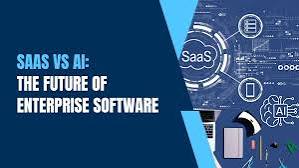
Is AI Replacing SaaS? What It Means for the Future of Software is a question facing businesses, developers, and technology buyers as AI becomes embedded in everyday tools. Rather than simply replacing software, AI is changing how software is built, delivered, and used.
The shift matters because AI can automate tasks that once required applications. This article explains where AI overlaps with SaaS, where SaaS remains essential, how models may evolve, and what companies should consider when choosing AI-powered software.
What Is SaaS?
SaaS, or Software as a Service, is a software delivery model in which users access applications through the internet rather than managing traditional locally installed software.
Common SaaS products handle specific business or personal functions, such as:
- Customer relationship management
- Project management
- Accounting
- Human resources
- Email marketing
- Communication
- File storage
- Analytics
- Design and collaboration
Instead of purchasing software once and maintaining it independently, customers typically subscribe to a service that the provider operates and updates.
The important point is that SaaS is a delivery and business model, while AI is a set of technologies and capabilities. That distinction is essential when considering whether AI can replace SaaS.
Read More: AI Models Explained: LLMs Reasoning and Multimodal AI
What Does AI Change About Software?
AI changes software primarily by making applications more capable of understanding inputs, generating outputs, predicting patterns, and completing tasks.
Traditional software generally depends on predefined interfaces and rules. A user selects options, enters information, and receives an output based on the application’s programmed functionality.
AI-powered software can introduce a more flexible interaction model.
For example, instead of navigating through multiple screens to create a report, a user might describe what they need in natural language. An AI system can interpret the request, work with available data, and produce a result.
This creates a fundamental shift:
Traditional software: Users operate the application.
AI-powered software: Users increasingly describe the outcome they want, while the system handles more of the process.
That does not automatically make SaaS obsolete. It changes what users expect from SaaS products.
Is AI Actually Replacing SaaS?
Not in a simple one-for-one sense.
AI is more accurately replacing or automating certain software functions and workflows rather than eliminating software as a whole.
Consider a marketing team. It may use separate tools for research, writing, analytics, customer management, scheduling, and reporting. AI can increasingly connect or automate parts of these workflows.
However, the underlying systems still need to provide:
- Data storage
- User authentication
- Permissions
- Integrations
- Security controls
- Billing
- Collaboration
- Administration
- Reliable infrastructure
AI can perform tasks within these systems, but businesses still need dependable software infrastructure around those capabilities.
The more useful question is therefore not “Will AI kill SaaS?” but:
How much of the traditional SaaS experience will AI absorb, automate, or redesign?
AI vs. SaaS: What’s the Real Difference?
AI and SaaS are often compared as though they are competing technologies. In reality, they operate at different levels.
| SaaS | AI |
|---|---|
| Software delivery model | Technology/capability |
| Provides applications through a service | Enables systems to perform intelligent tasks |
| Often organized around specific workflows | Can operate across multiple workflows |
| Usually requires users to interact with interfaces | Can support natural-language interaction |
| Subscription is a common business model | Can be embedded into many business models |
| Can operate without AI | Can be incorporated into SaaS |
This means a product can be both AI-powered and SaaS.
For example, an online project-management platform can remain a SaaS product while using AI to summarize meetings, identify tasks, generate reports, or answer questions about project data.

Why AI-Native Software Could Challenge Traditional SaaS
The bigger disruption may come from AI-native software.
Traditional SaaS was often designed around applications and screens. Users learn how a particular product works and then perform tasks within its interface.
AI-native products can be designed around goals, agents, automation, and natural-language interaction from the beginning.
Traditional SaaS Workflow
A simplified workflow might look like this:
User → Application → Features → Manual Actions → Result
AI-Native Workflow
An AI-native workflow may look more like:
User → Goal → AI reasoning/automation → Connected tools → Result
The difference is significant.
If an AI system can understand a goal and safely coordinate multiple actions, users may need fewer specialized interfaces for individual tasks.
However, this depends on reliability, permissions, integrations, data quality, and the complexity of the task.
Will AI Make SaaS Products Less Important?
AI could make some SaaS features less visible to users without eliminating the underlying software.
Imagine an employee asking an AI assistant:
“Find the customers who have not received a response this week and prepare follow-up messages.”
The user may not need to manually open several dashboards, filter records, export data, and draft messages.
Yet a CRM or customer database may still provide the underlying information and permissions required to complete the task.
In this situation, AI becomes the interface while SaaS remains part of the infrastructure.
This could change the relationship between users and software rather than eliminate software itself.
How AI Could Affect SaaS Business Models
AI may have a substantial impact on how software companies package and charge for their products.
Traditional SaaS commonly uses models such as:
- Per-user subscriptions
- Tiered plans
- Usage limits
- Feature-based plans
- Enterprise contracts
AI introduces additional possibilities because the cost and value of a service may depend on activity performed by AI.
Usage-Based Pricing
A company could charge according to the amount of AI processing, tasks completed, or other measurable usage.
Outcome-Based Models
In some cases, software providers may increasingly focus pricing around the business value or outcomes delivered rather than simply the number of users.
Hybrid Pricing
A product may combine a base subscription with usage-based AI charges.
For example:
Base platform fee + AI usage + premium features
The exact model will depend on the product, infrastructure costs, customer expectations, and the value provided.
AI Agents Could Be More Disruptive Than AI Chatbots
Chatbots primarily respond to user requests. AI agents aim to perform more complex sequences of actions with less continuous human intervention.
For example, an AI agent could potentially:
- Receive a business objective.
- Retrieve information from connected systems.
- Analyze that information.
- Create a plan.
- Perform authorized actions.
- Report the outcome to the user.
This creates an important challenge for traditional SaaS.
If one AI-driven system can coordinate several specialized applications, the user may spend less time interacting directly with each individual application.
That could reduce the importance of some software interfaces while increasing the importance of APIs, integrations, data access, security, and reliable backend systems.
What Happens to SaaS Companies in an AI-First Market?
SaaS companies are not necessarily facing a choice between AI or no AI.
Many can incorporate AI into their existing products.
A SaaS company might use AI to:
- Automate repetitive workflows
- Improve search
- Generate content
- Summarize information
- Analyze business data
- Provide recommendations
- Personalize experiences
- Assist customer support
- Create reports
- Build automated workflows
The strongest products may combine existing domain expertise with AI rather than simply adding a generic chatbot.
The Importance of Proprietary Data and Workflows
An AI model alone may not be enough to create a defensible software product.
A SaaS company may have valuable advantages through:
- Industry-specific workflows
- Customer data
- Integrations
- Existing distribution
- Domain expertise
- Compliance processes
- Established user relationships
- Specialized interfaces
These assets can remain valuable even as AI capabilities become more widely available.
Could AI Replace Some SaaS Tools?
Yes, some individual tools or categories of functionality may become less necessary.
The risk is higher when a product primarily performs a narrow, repetitive task that AI can accomplish through a simpler interface.
For example, if users previously needed a dedicated tool for a relatively straightforward content transformation, an AI assistant may eventually provide that capability directly.
But replacement becomes harder when software provides complex infrastructure, specialized workflows, collaboration, governance, integrations, or mission-critical processes.
A Simple Way to Think About the Risk
A SaaS product is potentially more exposed to AI disruption when it has:
- A narrow feature set
- Limited differentiation
- Easily replicated functionality
- Minimal proprietary data
- Few important integrations
- A workflow that can be described simply
It may be more resilient when it provides:
- Deep industry specialization
- Complex workflows
- Strong integrations
- Valuable proprietary data
- Enterprise controls
- Collaboration
- Security and compliance features
- A strong ecosystem
This is not a prediction about any specific company. It is a framework for evaluating where AI creates greater competitive pressure.
AI May Turn Software From Apps Into Interfaces
One of the most important changes could be the way people interact with computers.
For years, software interaction has largely revolved around:
Menus → Buttons → Forms → Dashboards → Reports
AI introduces another layer:
Intent → Natural language → Automated action
Instead of learning where every function exists, users can increasingly describe what they want.
This does not mean graphical interfaces will disappear. Complex tasks often benefit from visual controls, dashboards, tables, settings, and direct manipulation.
The future may therefore combine both approaches:
AI interface + traditional interface + automated workflows
What Does This Mean for Software Developers?
Developers will still be needed, but the nature of software development is changing.
AI coding tools can assist with tasks such as:
- Generating code
- Explaining existing code
- Writing tests
- Finding potential bugs
- Refactoring
- Documentation
- Prototyping
This can reduce the amount of manual work required for some development activities.
At the same time, software engineering involves much more than producing code.
Developers and engineering teams still need to think about:
- Architecture
- Security
- Reliability
- Performance
- Data models
- Testing
- Infrastructure
- Product requirements
- System integration
- Human oversight
AI can accelerate parts of development, but building dependable software remains a broader engineering problem.
What Does This Mean for Businesses Buying Software?
Businesses should not choose software simply because it advertises itself as “AI-powered.”
Instead, evaluate whether AI actually improves the workflow.
Ask:
1. What problem does the product solve?
Start with the business problem rather than the AI feature.
2. Does AI reduce meaningful work?
An AI feature is useful when it saves time, improves quality, increases accessibility, or enables something that was previously difficult.
3. What data does the AI access?
Understand what information is processed, where it goes, and what controls are available.
4. Can the AI make mistakes?
AI-generated outputs may require review, especially when decisions involve financial, legal, security, operational, or customer-impacting consequences.
5. What happens if the AI feature disappears?
A strong software purchase should still make sense based on its underlying functionality and business value.
Should Companies Replace SaaS With AI Tools?
Usually, the better approach is not to replace software simply because an AI alternative exists.
Instead, compare the complete workflow.
For each existing SaaS tool, ask:
- What tasks does it perform?
- Which tasks are repetitive?
- Which tasks could AI automate?
- What data does the application manage?
- What integrations are required?
- What security and permission controls are necessary?
- What happens if the AI produces an incorrect result?
- Is the existing SaaS product still providing unique value?
This approach helps businesses identify genuine opportunities for consolidation without sacrificing reliability.
The Future of SaaS: More AI, Fewer Manual Steps
The most likely future is not simply AI replacing SaaS.
Instead, software is likely to become increasingly AI-assisted, automated, and intent-driven.
SaaS products may evolve from collections of features into systems that actively help users complete objectives.
A project-management application, for example, could move beyond displaying tasks. Its AI capabilities might help organize work, summarize progress, identify missing information, or automate routine updates.
The underlying SaaS platform can still provide the structured data, permissions, collaboration environment, and integrations that make those actions possible.
A Practical Comparison
| Area | Traditional SaaS | AI-Enhanced SaaS | AI-Native Software |
|---|---|---|---|
| Primary interaction | Interface | Interface + AI | Intent + AI |
| Automation | Rule-based/manual | AI-assisted | AI-driven |
| User involvement | Often higher | Reduced | Potentially much lower |
| Data usage | Structured workflows | Structured + AI analysis | AI-centered workflows |
| Integrations | Important | Very important | Often fundamental |
| Human oversight | Depends on task | Important | Critical for sensitive actions |
| Business model | Often subscription | Subscription + possible usage | May vary widely |
These categories can overlap. A product can evolve from one model toward another over time.
What the Future of Software Could Look Like
The future may involve several software layers working together.
AI as the User Interface
Users communicate goals through natural language, voice, or other interfaces.
SaaS as the System of Record
Business applications continue to store structured information and manage workflows.
APIs as the Connection Layer
AI systems connect different applications and services.
Agents as the Automation Layer
AI agents coordinate multiple actions across connected systems.
Humans as Decision Makers
People remain responsible for important decisions, approvals, exceptions, and oversight.
This model suggests that AI does not necessarily destroy the software ecosystem. It can change how the different parts interact.
How Companies Can Prepare for the AI-SaaS Shift
Businesses can prepare without attempting to replace every existing application.
Audit Current Software
List the SaaS tools your organization uses and identify overlapping functions.
Identify Repetitive Work
Look for tasks involving copying information, summarizing, categorizing, drafting, searching, or routine reporting.
Test AI Where Risk Is Low
Start with workflows where mistakes are easy to identify and correct.
Protect Sensitive Data
Establish clear rules for what information employees can provide to AI systems and which approved tools can process business data.
Measure Outcomes
Evaluate whether AI actually reduces work, improves quality, or increases productivity.
Avoid AI for AI’s Sake
Adding an AI feature does not automatically improve a product. The technology should solve a genuine user problem.
Frequently Asked Questions
Is AI going to replace SaaS?
AI is unlikely to eliminate SaaS as a whole. It is more likely to automate individual SaaS functions, change user interfaces, and encourage new software business models.
Will AI replace SaaS companies?
Some SaaS companies may face significant competition if their products provide narrow functionality that AI can reproduce easily. Others can remain valuable by combining AI with specialized workflows, data, integrations, and infrastructure.
Is AI the same as SaaS?
No. SaaS is primarily a way of delivering and commercializing software, while AI refers to technologies that enable systems to perform tasks such as generating, analyzing, predicting, or reasoning over information.
What is AI-native software?
AI-native software is designed around AI capabilities from the beginning rather than adding AI to an existing application as an additional feature.
Will SaaS become cheaper because of AI?
AI could reduce the cost of performing some software-supported tasks, but pricing depends on infrastructure, demand, competition, product value, and the provider’s business model. Lower AI costs do not automatically mean lower SaaS prices.
Should businesses stop buying SaaS because of AI?
No. Businesses should evaluate whether a SaaS product solves an important problem and whether its AI capabilities improve the workflow. Replacing software without considering security, integrations, data, and reliability can create new problems.
What skills will matter in the future of software?
Technical skills will remain important, but understanding AI tools, automation, data, system integration, security, product requirements, and human oversight will become increasingly useful.
Conclusion
Is AI Replacing SaaS? The better answer is that AI is transforming SaaS rather than simply eliminating it. Some narrow software functions may become automated or absorbed into AI assistants, while SaaS platforms can continue providing data, infrastructure, integrations, security, and specialized workflows. The future of software will likely combine AI-driven interaction with dependable software systems, creating products that require less manual work while delivering more intelligent and automated experiences.
