

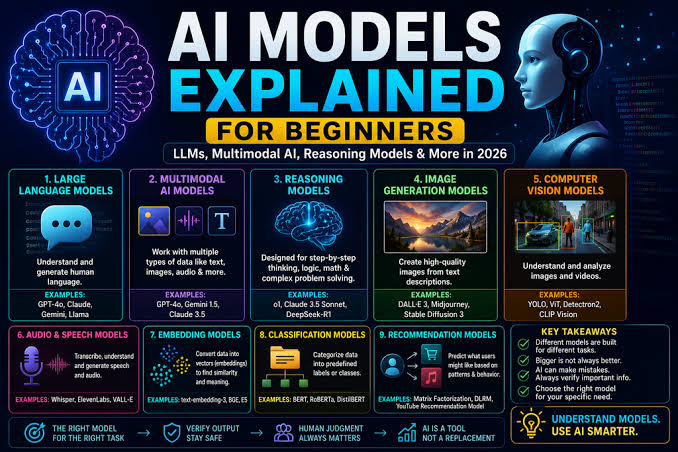
AI models are behind many tools people use for writing, research, coding, image generation, and everyday productivity. However, terms such as LLMs, reasoning models, and multimodal AI can be confusing. Each type is designed to process information differently, and choosing the right model depends on the task you want to complete.
This guide explains AI Models Explained: LLMs, Reasoning, and Multimodal AI in simple terms. You will learn how these models work, how they differ, where they are used, their strengths and limitations, and how to decide which type of AI model is best for a particular task.
What Is an AI Model?
An AI model is a computational system trained to recognize patterns and produce useful outputs from input data.
Depending on how it is designed, an AI model may work with:
- Text
- Images
- Audio
- Video
- Code
- Structured data
- Multiple types of information
Modern AI models can perform tasks such as generating text, answering questions, analyzing images, writing software, summarizing documents, and solving problems.
However, not all AI models work in the same way.
Some are optimized for language generation. Others are designed to spend more computational effort on complex reasoning. Multimodal models can work across different types of input.
That is why understanding the differences between AI models is useful when choosing an AI tool.
Read More: Best AI Tools for Small Business Automation in 2026
What Is an LLM?
LLM stands for Large Language Model.
An LLM is an AI model trained on large amounts of data so that it can process and generate natural language.
Common LLM tasks include:
- Writing
- Summarization
- Translation
- Question answering
- Brainstorming
- Classification
- Text analysis
- Code generation
A simplified example is:
User: Write a professional email asking for a project update.
LLM: Generates an appropriate email based on the instructions.
The model predicts and generates sequences of tokens based on patterns learned during training and the context provided in the conversation.

Why Are LLMs Called “Large”?
The word “large” can refer to several aspects of a model, including its number of learned parameters and the scale of training data and computation used to develop it.
However, bigger does not automatically mean better for every task.
A smaller model can sometimes be faster, cheaper, or more suitable for a specific application.
The best model depends on factors such as:
- Task complexity
- Speed requirements
- Cost
- Context requirements
- Accuracy
- Hardware
- Privacy requirements
How Do LLMs Work?
A simplified LLM workflow looks like this:
Input → Tokenization → Model processing → Next-token prediction → Output
Suppose you enter:
“Write a short explanation of cloud computing.”
The text is converted into tokens that the model can process.
The model then uses the context to generate an output token by token.
Modern language models use transformer-based architectures or related techniques to process relationships between tokens efficiently.
This allows them to handle complex language patterns and long pieces of context.
However, an LLM does not automatically “know” whether every statement it generates is true.
It can produce incorrect information, misunderstand a question, or confidently generate an unsupported answer.
What Are Reasoning Models?
Reasoning models are AI systems designed to perform more deliberate computation on difficult problems.
They are particularly useful for tasks involving:
- Mathematics
- Logic
- Programming
- Planning
- Multi-step analysis
- Complex problem solving
Instead of focusing primarily on producing an immediate response, reasoning-oriented systems can allocate additional computation to work through challenging problems before producing an answer.
A simple example is:
Question: If a business has three departments with different budgets and several constraints, how should its total budget be allocated?
A reasoning-oriented model can be useful because the problem requires multiple steps rather than simple text generation.
LLM vs Reasoning Model
The distinction is not always absolute.
Many modern AI systems can perform both language generation and reasoning-related tasks.
| Feature | General LLM | Reasoning-Oriented Model |
|---|---|---|
| Text generation | Strong | Strong |
| Summarization | Strong | Strong |
| Simple questions | Excellent | Often unnecessary |
| Complex mathematics | Varies | Often better suited |
| Multi-step logic | Varies | Designed for this |
| Coding | Strong | Often useful for difficult problems |
| Speed | Often faster | May require more computation |
| Best use | Everyday language tasks | Complex problem solving |
The key idea is that reasoning is a capability or design emphasis, not simply a completely separate category from language models.
A reasoning model can still be an LLM or part of a broader generative AI architecture.
What Is Multimodal AI?
Multimodal AI can process or generate more than one type of information.
For example, a multimodal model may work with:
- Text
- Images
- Audio
- Video
A text-only system might receive:
“Describe this photograph.”
A multimodal system can receive the photograph itself and analyze visual information alongside the user’s text.
This makes multimodal AI useful for tasks where information is naturally presented in different formats.
How Multimodal AI Works
A simplified multimodal workflow is:
Text/Image/Audio/Video → Processing → Shared or coordinated representation → Model reasoning → Output
The exact architecture differs between AI systems.
A multimodal model may need to identify information from an image, understand the user’s question, combine both sources of information, and produce a response.
For example:
Input: A photograph of a product plus the question, “What components are visible?”
The system can use visual information to answer the question.
Examples of Multimodal AI
Multimodal AI can support many practical tasks.
Image Analysis
Users can ask AI to:
- Describe an image
- Extract information from a visual
- Analyze a diagram
- Explain a chart
- Identify visible objects
Document Understanding
A multimodal system may help interpret documents containing:
- Text
- Tables
- Charts
- Images
- Forms
Voice Interaction
AI assistants can combine spoken input with language understanding to support conversational interactions.
Video Analysis
Some advanced AI systems can process video-related information, depending on their capabilities and supported inputs.
This can support tasks such as summarization, content analysis, and understanding events in visual media.
LLMs vs Multimodal AI
An LLM is primarily associated with language.
Multimodal AI expands beyond a single information format.
| Capability | Language Model | Multimodal Model |
|---|---|---|
| Text | Yes | Yes |
| Images | Depends on system | Yes |
| Audio | Depends on system | May support |
| Video | Depends on system | May support |
| Text generation | Yes | Yes |
| Image understanding | Not necessarily | Yes |
| Cross-modal tasks | Limited | Core capability |
It is important not to treat “LLM” and “multimodal AI” as mutually exclusive.
A multimodal AI system can include a language model as an important component.
AI Models Explained With a Simple Example
Imagine you give an AI three tasks.
Task 1: Write an Email
You ask:
“Write a polite email requesting a meeting.”
A general language model is usually appropriate.
Task 2: Solve a Complex Logic Problem
You provide a problem with several conditions and ask for a solution.
A reasoning-oriented model may be more suitable.
Task 3: Analyze a Business Chart
You upload a chart and ask:
“What trend does this chart show?”
A multimodal model is useful because the system needs to interpret visual information and language together.
The task determines the model type that makes the most sense.
Why Reasoning Requires More Computation
Complex reasoning can require more processing than straightforward text generation.
Consider two prompts:
“Write a product description for a laptop.”
and
“Analyze these constraints and determine the optimal schedule.”
The second problem may require several intermediate steps.
Reasoning-oriented systems are designed to handle such problems with additional computation.
This can sometimes involve a trade-off between:
Accuracy and problem-solving ability ↔ Speed and computational cost
The balance depends on the model and the specific task.
What Are AI Models Used For?
AI models are now used across many industries.
Business
Businesses use AI for:
- Customer support
- Document processing
- Market research
- Content creation
- Data analysis
- Workflow assistance
Software Development
Developers use AI for:
- Code generation
- Debugging
- Documentation
- Testing
- Code explanation
- Refactoring
Education
AI can help with:
- Explanations
- Study materials
- Practice questions
- Summaries
- Tutoring-style interactions
Healthcare
AI research and applications can support areas such as medical image analysis, documentation, and research.
High-stakes healthcare applications require appropriate professional oversight and validation.
Marketing
Marketing teams can use AI for:
- Content ideas
- Copywriting
- Audience research
- Image generation
- Campaign planning
- Content analysis
What Is Generative AI?
Generative AI refers to AI systems capable of generating new content.
That content can include:
- Text
- Images
- Audio
- Video
- Code
LLMs are one category of generative AI technology.
Multimodal generative AI can work across multiple content types.
For example:
Text prompt → Image
or:
Image + text question → Text explanation
This is why generative AI and AI models are related but not identical terms.
AI Model Training vs Inference
Two important terms are training and inference.
Training
During training, a model learns patterns from its training data through a large-scale computational process.
The model’s parameters are adjusted during this process.
Inference
Inference happens when the trained model is used to process new input and generate an output.
For example:
Training: The model is developed.
Inference: You ask the model a question and receive an answer.
Understanding this difference helps explain why running an AI model can require significant computing resources even after training is complete.
Why AI Models Need So Much Computing Power
Large AI models can require substantial computing resources.
Training may involve large datasets and specialized hardware.
Inference can also require significant computational resources, particularly when:
- Models are large
- Context windows are long
- Inputs include images or video
- Complex reasoning is performed
- Many users access the system simultaneously
This is one reason AI infrastructure increasingly relies on specialized processors and large data centers.
What Are AI Chips?
AI chips are specialized processors designed to efficiently perform the mathematical operations used by AI workloads.
Examples of hardware used for AI include:
- GPUs
- TPUs
- NPUs
- Specialized AI accelerators
GPUs became especially important for AI because their architecture can handle many parallel mathematical operations efficiently.
NPUs are increasingly included in personal devices to accelerate certain AI workloads locally.
Cloud AI vs On-Device AI
AI models can operate through cloud infrastructure or, for some workloads, directly on a device.
| Feature | Cloud AI | On-Device AI |
|---|---|---|
| Processing | Remote servers | Local device |
| Internet dependency | Often required | Can support offline tasks |
| Model size | Can be very large | Usually constrained |
| Privacy potential | Data may leave device | Data can potentially stay local |
| Hardware requirement | Lower on user device | Higher device requirements |
| Best for | Complex workloads | Supported local tasks |
On-device AI does not automatically guarantee privacy, but keeping processing local can reduce the need to send certain information to remote services.
How to Choose the Right AI Model
Start with the task rather than the model’s popularity.
Ask these questions:
Do I mainly need text generation?
Choose a capable language model.
Do I need complex problem solving?
Consider a reasoning-oriented model.
Do I need image or audio understanding?
Choose a multimodal system that supports the required input.
Do I need fast responses?
A smaller or optimized model may be more appropriate.
Do I need local processing?
Look for a model and device that support on-device inference.
Do I need business-grade privacy?
Evaluate the provider’s data handling, security, administrative controls, and contractual terms.
Common AI Model Limitations
No AI model is perfect.
Common limitations include:
- Incorrect answers
- Hallucinated information
- Bias
- Limited or outdated knowledge
- Poor interpretation of ambiguous prompts
- Security risks
- Inconsistent outputs
Multimodal systems can also misunderstand images, diagrams, or audio.
Reasoning models can make mistakes in logic or calculations.
Therefore, users should verify important outputs.
How to Get Better Results From AI Models
Give Clear Instructions
Instead of:
“Write something about marketing.”
Try:
“Write five short marketing ideas for a small online clothing store targeting university students.”
Provide Relevant Context
Explain the goal, audience, format, and constraints.
Break Down Complex Tasks
For complicated projects, divide the work into stages.
Verify Important Information
Do not assume AI-generated information is correct simply because the answer sounds confident.
Choose the Right Model
A simple writing task does not necessarily require the most advanced reasoning model.
Likewise, a visual analysis task may require multimodal capabilities.
Future of AI Models
AI models are increasingly becoming more capable across multiple dimensions.
Future development is likely to continue focusing on:
- Better reasoning
- Longer context
- Multimodal understanding
- Tool use
- Agentic workflows
- Faster inference
- Smaller efficient models
- On-device AI
- Specialized models
- Improved reliability
The boundaries between categories may also become less obvious.
A single AI system can increasingly combine language, reasoning, vision, audio, tools, and other capabilities.
That means users may eventually think less about selecting a “type” of AI model and more about selecting the right capability for a specific task.
Frequently Asked Questions
What is an LLM in simple terms?
An LLM, or Large Language Model, is an AI system trained to process and generate language. It can perform tasks such as writing, summarization, translation, question answering, and coding.
What is a reasoning AI model?
A reasoning-oriented AI model is designed to devote additional computation to complex problems involving logic, mathematics, planning, coding, or multiple steps.
What is multimodal AI?
Multimodal AI can process or generate multiple types of information, such as text, images, audio, or video, depending on the system.
Is ChatGPT an LLM?
ChatGPT is an AI application that uses OpenAI models. The specific underlying model can vary over time and by product or plan, so “ChatGPT” and “LLM” are not interchangeable terms.
Are reasoning models better than LLMs?
Not necessarily. Reasoning-oriented models can be useful for complex problems, while general language models can be faster and more suitable for everyday writing, summarization, and conversation.
Can an AI model understand images?
Some AI models can process images. These are generally described as multimodal systems when they can combine visual information with other modalities such as text.
What is the difference between AI and an AI model?
AI is the broader field and technology category. An AI model is a specific computational system trained to perform particular tasks within that field.
Which AI model should I use?
Choose according to your task. Use a general language model for everyday text tasks, a reasoning-oriented model for difficult multi-step problems, and a multimodal model when your task involves images, audio, or other supported modalities.
Conclusion
Understanding AI models becomes easier when you separate them by their primary capabilities. LLMs specialize in processing and generating language, reasoning-oriented models focus on difficult multi-step problems, and multimodal AI can work across formats such as text, images, audio, and video.

1 Comment
Pingback: Is AI Replacing SaaS? What It Means for the Future of Software