


The smartwatch took over the wrist a decade ago. In 2026, the most interesting health tracker is moving one joint down the hand: the smart ring. These tiny titanium bands quietly measure your sleep, heart rate, and recovery around the clock — no screen, no buzzing notifications, no nightly charging ritual.
But are smart rings actually worth the money, or are they an expensive gadget looking for a problem? This guide explains what Smart Rings track, how the technology works, and how the leading models compare — from the Oura Ring to the Samsung Galaxy Ring. If you are still deciding between wearable types, our breakdown of the best smartwatches and their features will help you compare what a wrist-based device offers instead.
What Are Smart Rings?
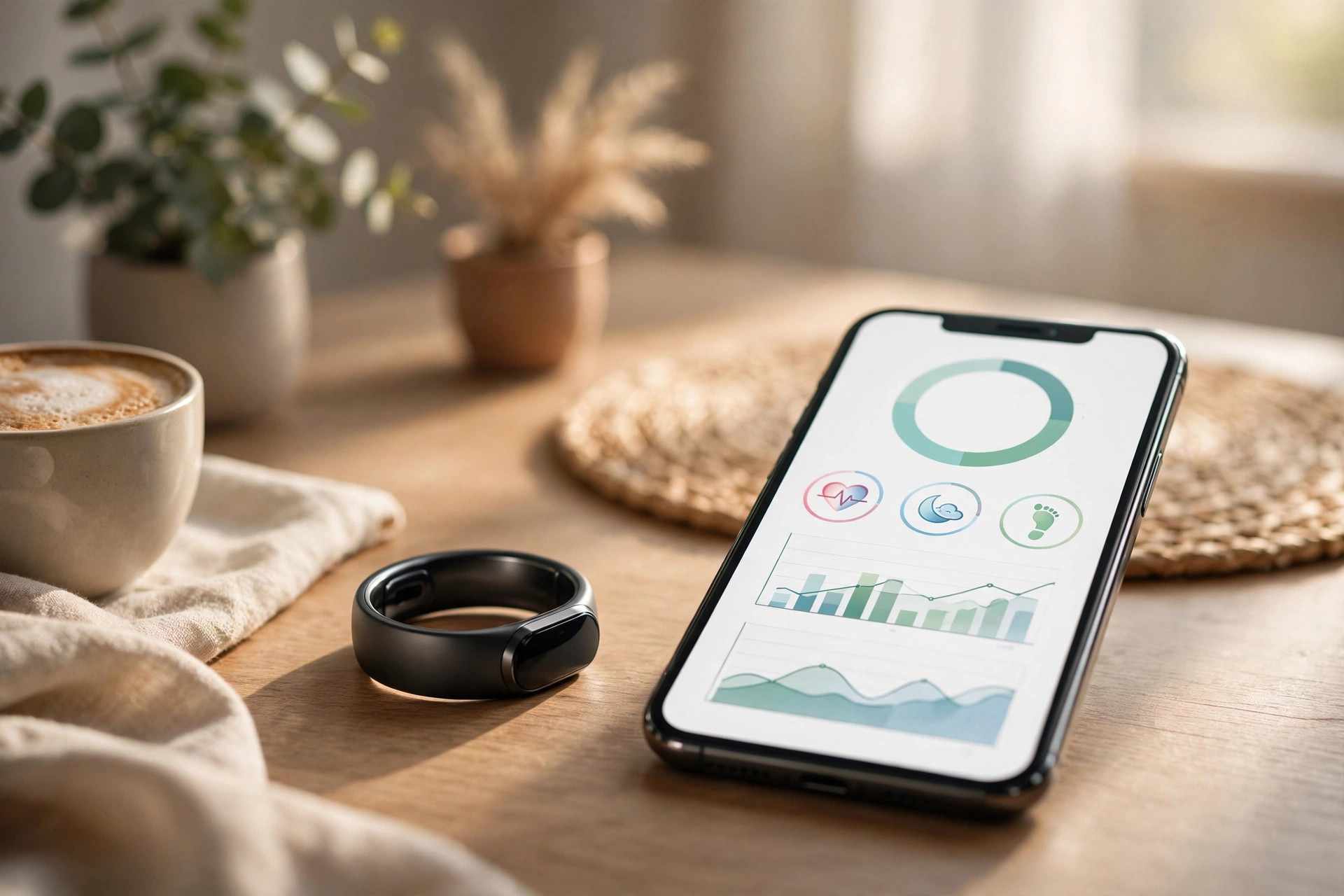
A smart ring is a finger-worn wearable that tracks health and sleep metrics and syncs the data to a phone app. Most are made of titanium, weigh between 2 and 5 grams, and have no screen at all.
Instead of displaying information, the ring collects it. Three sensors sit on the inside of the band:
- PPG sensors (photoplethysmography): multi-wavelength LEDs that shine light into the skin and read how blood absorbs it, measuring heart rate and blood oxygen.
- Skin temperature sensor: detects subtle temperature shifts linked to illness, recovery, and menstrual cycles.
- Accelerometer: tracks movement for sleep detection, step counting, and activity levels.
The app does the talking. Every morning you get a readiness or recovery score that tells you how well you slept and how hard you can push your body that day.
How Do Smart Rings Work?
Smart rings work by reading the pulse in your finger’s arteries. Blood flow near the surface of the finger gives a stronger, cleaner optical signal than the wrist — and that single anatomical fact explains the entire product category.
A typical day with a smart ring looks like this:
Wear the ring → sensors collect heart rate, HRV, temperature, and movement all day → data syncs to the app over Bluetooth → the app calculates sleep stages, recovery, and readiness → you check your morning score and adjust your day.
The ring runs continuously, including overnight, because the finger is a low-interference spot for sensors. Rolling over in bed rarely breaks the signal the way it does on a wrist, which is why sleep tracking is the category’s strongest feature.
What Do Smart Rings Track?
Every major smart ring in 2026 reads the same core signals. The differences live in the software that interprets them, not the hardware.
- Sleep stages: light, deep, and REM sleep, plus total sleep time, latency (how fast you fall asleep), and wake-ups.
- Heart rate and HRV: resting heart rate, nighttime heart rate variability, and trends over weeks.
- Blood oxygen (SpO2): overnight saturation, used to estimate breathing disturbances.
- Skin temperature: nightly deviations from your personal baseline, an early signal of illness or overtraining.
- Activity: steps, active calories, and automatic workout detection on most models.
- Readiness/recovery scores: a daily summary number combining sleep, HRV, temperature, and activity.
- Cycle tracking: temperature-based predictions of menstrual cycle phases.
- Stress and respiratory rate: daytime stress estimates and overnight breathing rates.
What they do not track: blood pressure (some 2026 models add trend estimates, but these are not medical-grade readings), blood glucose in real time, or ECG — the ring form factor is too small for clinical electrodes.
Smart Rings vs Smartwatches: The Accuracy Question
Rings and watches use the same sensor physics, so neither is magically better. The finger simply gives a cleaner signal at rest, while the wrist gives a more practical signal during the day.
- Sleep tracking: rings win. Cleaner pulse signal plus fewer motion artifacts means more reliable sleep staging.
- Resting heart rate and HRV: rings win, for the same reason — overnight readings are the gold standard, and rings measure them best.
- Real-time workout heart rate: watches win. A finger moves constantly during exercise, and rings have no grip on stride cadence or wrist swing. Serious runners should treat ring workout data as supplemental, not authoritative.
- GPS and pace: watches win. Rings have no GPS, so distance comes from the phone or step estimates.
- Convenience features: watches win. Notifications, calls, payments, and music controls need a screen.
The honest framing: a smart ring is a recovery and sleep specialist, while a smartwatch is a fitness and communication generalist. Many athletes now wear both — the ring for recovery, a chest strap or watch for training.
Why Smart Rings Win at Sleep Tracking
Sleep is where the finger’s advantage is largest, and it is the number-one reason people buy these rings. Three factors combine:
- Signal quality: finger arteries sit closer to the surface than wrist arteries, producing a tighter pulse waveform with fewer dropouts.
- Motion resistance: the ring moves with your hand rather than sliding around a wrist, so tossing and turning corrupts fewer readings.
- Comfort: a 2–5 gram ring is easier to sleep in than a 40+ gram watch. People who hated wearing a watch to bed actually keep the ring on — and the best tracker is the one you wear.
Independent testers consistently rank the leading rings’ sleep staging close to dedicated sleep trackers and ahead of most wrist wearables. Oura’s algorithms, built on the largest longitudinal dataset in the category, remain the most refined — though the hardware gap between brands is narrower than marketing suggests.
Where Smart Rings Still Fall Short
Smart rings are specialists, and specialists have blind spots. Know these before you buy:
- Exercise accuracy: real-time heart rate during running, lifting, or cycling is noticeably less accurate than a wrist optical sensor or chest strap.
- No display: you cannot check the time, see who is calling, or read a notification on a ring.
- No GPS: route tracking requires your phone.
- Fixed sizing: one ring fits one finger. Gain or lose weight, and the fit changes — fingers also swell in heat.
- Durability limits: titanium resists scratches, but the inner sensor epoxy can wear with heavy weightlifting or rock climbing.
- Not medical devices: ring data shows trends, not diagnoses. No ring in 2026 replaces a doctor, a sleep study, or a blood pressure cuff.
Oura Ring 4 and Ring 5: The Category Leaders
Oura invented the modern smart ring, and its products still set the benchmark for app quality and sleep accuracy.
- Oura Ring 4: priced $349–$499 depending on finish, up to 8 days of battery, titanium build, 10 ATM water resistance, works with iOS and Android.
- Oura Ring 5: the 2026 flagship at $399–$499, roughly 40% smaller and lighter than the Ring 4, 6–9 day battery, new Blood Pressure Signals trend metrics and nighttime breathing insights, plus an optional charging case.
- The catch: the $5.99/month membership ($69.99/year) is effectively mandatory. Without it you keep basic scores, but readiness, detailed sleep stages, HRV trends, and cycle insights lock.
Oura has the deepest longitudinal insight engine and the widest third-party integrations in the category. If sleep data quality is your top priority and you accept the ongoing fee, it remains the accuracy champion.
Samsung Galaxy Ring: The Galaxy-Only Contender
Samsung’s entry is the most polished ring for Android users — with a hard ecosystem wall.
- Price: around $399 at launch, frequently discounted to $299 or below.
- Subscription: none. Every feature is included with the hardware.
- Battery: up to 7 days.
- Design: 2.3–3.0 grams, 7.0 mm wide, concave titanium band, 10 ATM water resistance.
- Standout features: Energy Score in Samsung Health, automatic workout detection, heart rate alerts, gesture controls for the phone camera, and Find My Ring.
- The catch: Android only, and the full feature set is reserved for Samsung Galaxy phones.
For Galaxy owners, the seamless Samsung Health integration makes this the obvious pick. iPhone users should look elsewhere — it simply does not work with iOS.
Ultrahuman Ring Pro: The No-Subscription Alternative
Ultrahuman built its reputation as the no-subscription Oura alternative — and survived a patent war to keep selling in the US.
- The backstory: Oura won an ITC patent case in 2025 that blocked imports of the original Ultrahuman Ring AIR in the US. Ultrahuman redesigned the hardware, cleared customs, and now sells the Ring Pro ($479) stateside.
- Price: Ring Pro $479; the Ring AIR remains available around $349 in other markets.
- Subscription: none, ever. One purchase, lifetime access.
- Battery: 4–6 days, the shortest in this roundup.
- Strengths: deep recovery and metabolic insights, PowerPlugs add-ons for caffeine and workout guidance, and biohacker-friendly data export.
If you want Oura-level insight depth without a monthly bill and do not mind charging twice a week, Ultrahuman is the most direct alternative.
RingConn Gen 2: Battery Champion With No Fees
RingConn settled its own patent dispute with Oura through a licensing agreement and has sold in the US throughout — quietly becoming the value pick.
- Price: $299, with a $199 Gen 2 Air for budget buyers.
- Subscription: none.
- Battery: 10–12 days — roughly double the rest of the category — with a portable charging case in the box.
- Standout feature: FDA-cleared sleep apnea monitoring, genuinely uncommon at this price.
- Trade-offs: sleep-stage and HRV algorithms trail Oura and Ultrahuman slightly; the app is more dashboard than narrative; 5 ATM water resistance (fine for showers, less ideal for serious swimmers).
- Coming up: the Gen 3, shown at CES 2026, adds a haptic motor, 10–14 day battery, 10 ATM rating, and nighttime blood-pressure trend tracking.
For buyers who want maximum battery and zero fees at a mid-tier price, the RingConn Gen 2 is the easiest recommendation in 2026.
Smart Rings Compared: 2026 Specs Table
Here is how the four leading smart rings stack up side by side:
| Ring | Price | Subscription | Battery | Water Rating | Works With |
|---|---|---|---|---|---|
| Oura Ring 4 | $349–$499 | $5.99/mo | Up to 8 days | 10 ATM | iOS + Android |
| Samsung Galaxy Ring | ~$399 | None | Up to 7 days | 10 ATM | Android only |
| Ultrahuman Ring Pro | $479 | None | 4–6 days | 10 ATM | iOS + Android |
| RingConn Gen 2 | $299 | None | 10–12 days | 5 ATM | iOS + Android |
Prices shift with sales — the Galaxy Ring in particular has been widely discounted. Confirm the current price before buying.
The Subscription Question: True Cost of Ownership
The sticker price lies. A smart ring’s real cost is hardware plus years of fees, and this is where Oura’s membership changes the math completely.
| Ring | Hardware | 1-Year Total | 3-Year Total |
|---|---|---|---|
| Oura Ring 4 | $349–$499 | ~$421–$571 | ~$565–$715 |
| Samsung Galaxy Ring | ~$399 | ~$399 | ~$399 |
| Ultrahuman Ring Pro | $479 | $479 | $479 |
| RingConn Gen 2 | $299 | $299 | $299 |
The part Oura’s marketing downplays: cancel the membership and you keep only basic daily scores. The advanced insights, detailed trends, and much of your history lock until you resubscribe — so the fee is an ongoing dependency, not a one-time tax.
Neither model is wrong. If Oura’s best-in-class algorithms are worth $72 a year to you, pay it. If the idea of renting insights from hardware you bought bothers you, every other ring on this list charges exactly once.
Smart Ring Battery Life: Real-World Numbers
Battery life is the practical differentiator nobody talks about enough. A ring that needs charging every four days is a ring you will eventually stop wearing.
- RingConn Gen 2: 10–12 days, plus a charging case with multiple top-ups — effectively a month between wall charges.
- Oura Ring 4: 5–8 days in real use, depending on how often the app syncs.
- Samsung Galaxy Ring: 5–7 days.
- Ultrahuman Ring Pro / AIR: 4–6 days, the most charge-hungry of the group.
Heavy Bluetooth syncing, frequent app checks, and cold weather all shave a day or two off these figures. If you hate charging wearables, battery life alone can decide your purchase.
Sizing Kits: The Step You Cannot Skip
Smart rings come in fixed sizes — there is no adjustable band. Every major brand ships a free sizing kit before your real ring, and skipping the trial period is the most common buyer mistake.
Step 1: Order the Sizing Kit
Every brand includes it free with purchase. Wear the plastic sizers, not your best guess from a jewelry ring — smart rings are wider and fit differently.
Step 2: Wear the Sizer for 24–48 Hours
Wear it through a full day and night, including a workout if you train. Fingers swell in heat and after exercise, and shrink in the cold.
Step 3: Pick the Snug-but-Comfortable Size
The ring should sit snugly enough that the sensors stay in contact with your skin, but loose enough to rotate slightly and slide off over your knuckle without force.
Step 4: Choose Your Finger
Index, middle, or ring finger all work. Most people get the best sensor contact on the index or middle finger of their non-dominant hand.
A ring that is too loose gives noisy data; one that is too tight is unwearable. Take the two days — it is the difference between a tracker you love and a $400 paperweight.
Are Smart Rings Accurate?
For what they are designed to do — track sleep, resting heart rate, HRV, and temperature trends — the leading smart rings are genuinely accurate. Independent testing puts the best rings’ sleep staging on par with dedicated sleep trackers and ahead of most wrist wearables.
The important qualifiers:
- Trends beat snapshots. A ring is excellent at showing that your HRV dropped 15% this week; it is not a clinical diagnostic tool.
- Exercise heart rate is the weak spot. Real-time readings during workouts lag behind wrist sensors and chest straps — significantly during high-intensity intervals.
- Algorithms matter more than sensors. All four rings read the same raw signals. Oura’s edge comes from years of dataset refinement, not better LEDs.
- New metrics are estimates. 2026’s blood-pressure trend features (Oura Ring 5, RingConn Gen 3) show cardiovascular patterns, not clinical blood-pressure readings. Treat them as wellness signals, not medical data.
Rings are not medical devices, and no brand claims FDA clearance for diagnosing conditions — with the notable exception of RingConn’s sleep apnea monitoring feature.
Smart Ring Privacy: What Happens to Your Health Data?
A ring collects your most intimate data — when you sleep, when your heart races, when your temperature spikes. Before buying, know where that data goes.
- Read the privacy policy. Check whether the company sells anonymized data, shares it with advertisers, or uses it for research. Policies differ sharply between brands.
- Check data export. The best rings sync freely with Apple Health and Google Fit and let you export your raw data. Some keep your history effectively locked inside their own app.
- Know what cancellation costs. With Oura, cancelling the membership also locks much of your historical insight data until you resubscribe.
- Review app permissions. The companion app should need Bluetooth and health-data access — nothing more. Deny location unless the app gives a clear reason.
- Prefer on-device processing where offered. Some metrics can be computed on the phone rather than in the cloud, reducing exposure.
As a rule: a company whose business model is a hardware sale has fewer incentives to monetize your data than one built on subscriptions and engagement. Neither is automatically unsafe — but the incentive structure is worth ten minutes of reading.
Who Should Buy a Smart Ring?
Smart rings suit a specific buyer profile. You are likely a good fit if:
- You care about sleep and recovery more than workout stats — the ring’s strongest domain.
- You hate wearing a watch to bed (or at all) but still want health tracking.
- You want discreet tracking — a ring draws zero attention in meetings, at weddings, or at the gym.
- You are a data-driven optimizer who will actually act on readiness scores, HRV trends, and temperature deviations.
- You dislike screens and notifications on your body and want a wearable that stays silent.
- You already train with a chest strap or watch and want the ring purely for recovery and sleep.
Who Should Not Buy a Smart Ring?
Be equally honest about the other side. Skip the ring if:
- You are a serious endurance athlete who needs accurate real-time heart rate, GPS, and pace — a sports watch or chest strap serves you better as the primary device.
- You want notifications, calls, and payments on your wrist — rings cannot do any of that.
- You expect medical diagnosis — rings track wellness trends, not conditions. See a doctor for real health concerns.
- Your finger size fluctuates a lot — pregnancy, certain medications, or manual labor that swells your hands can make a fixed-size ring impractical.
- You will not pay a subscription on principle and want Oura specifically — the membership is non-negotiable for the full experience.
- You are buying for a child — rings are sized and calibrated for adult fingers and adult baselines.
Smart Ring Buying Checklist for 2026
Run through this list before you order to avoid the common regrets:
- ☐ Decide: subscription or one-time purchase — this single choice eliminates half the options.
- ☐ Match the ring to your phone: Galaxy Ring needs Android; everything else works with iPhone and Android.
- ☐ Order the free sizing kit and wear it for 48 hours before choosing.
- ☐ Compare 3-year total cost, not sticker price.
- ☐ Check the return policy — you need at least two weeks of sleep data to judge accuracy.
- ☐ Read the privacy policy’s data-sharing section.
- ☐ Confirm water resistance matches your life: 10 ATM for swimmers, 5 ATM is fine for showers.
- ☐ If you lift heavy, check whether the brand’s warranty covers sensor-epoxy wear.
Smart Rings in 2026: The Verdict
Smart rings have grown from a niche curiosity into a mature category with clear winners. The technology works — particularly for sleep and recovery — and the finger’s signal advantage over the wrist is real physics, not marketing.
The buying decision comes down to three questions. Subscription or not? If yes, Oura’s accuracy lead is worth the fee. If no, RingConn Gen 2 wins on value and battery, Ultrahuman on insight depth. iPhone or Android? Galaxy owners get a tailored experience from Samsung’s ring; everyone else picks from the universal three. What do you actually want measured? Sleep and recovery → any ring on this list. Serious training data → keep the chest strap and let the ring handle the nights.
Buy the ring for what it does best, and it will quietly become the wearable you forget you are wearing — which is exactly the point.
For a general technical overview of the device category, see Smart ring on Wikipedia.
Smart Rings FAQ
Can a smart ring replace my smartwatch?
For sleep and recovery tracking, yes — most users find the ring’s data better. For notifications, GPS workouts, calls, and payments, no. Many people wear a ring for health and keep a basic watch (or nothing) for everything else.
Do smart rings work without a subscription?
RingConn, Samsung Galaxy Ring, and Ultrahuman include every feature with the hardware purchase — no subscription exists. Only Oura requires its $5.99/month membership for the full feature set; without it, advanced insights lock.
How long do smart rings last on a charge?
RingConn Gen 2 leads at 10–12 days, Oura Ring 4 manages 5–8 days, the Galaxy Ring 5–7 days, and Ultrahuman 4–6 days. Charging cases (RingConn, Oura Ring 5) extend effective time between wall charges further.
Are smart rings waterproof?
Oura, Samsung, and Ultrahuman rings are rated 10 ATM (100 meters), suitable for swimming. The RingConn Gen 2 is rated 5 ATM — fine for showers and shallow water, but serious swimmers should consider the Gen 3’s 10 ATM rating.
Can I wear a smart ring while lifting weights?
Yes, but heavy barbell work can scratch the titanium and wear the inner sensor coating over time. Many lifters wear the ring on a non-grip finger or remove it for heavy sessions.
Do smart rings work for small or large fingers?
Brands offer sizes roughly equivalent to US ring sizes 6–13. Always use the free sizing kit for 48 hours — finger size changes with temperature and activity, and a wrong size means noisy data or an unwearable ring.
Conclusion
Smart rings in 2026 are no longer an experiment. They track sleep, heart rate variability, blood oxygen, temperature, and recovery from your finger with accuracy that beats most wrist wearables where it matters most — overnight.
Choose Oura if you want the most refined insights and accept the subscription. Choose RingConn Gen 2 for the best battery and value with no fees. Choose the Galaxy Ring if you live in Samsung’s ecosystem, or Ultrahuman if you want deep insights without a monthly bill. Whichever you pick, wear the sizing kit first, compare the three-year cost, and let the ring do what it does best: quietly watch over your recovery while you sleep.
