
AI agents are software systems designed to do more than generate answers. They can interpret a goal, plan actions, use tools, gather information, make decisions within defined boundaries, and work through multiple steps to complete a task. This makes them different from a basic chatbot that primarily responds to individual prompts.
The idea of AI agents has become increasingly important as artificial intelligence moves from simple content generation toward task automation. From customer support and software development to research and business operations, AI agents can connect models with tools and workflows to accomplish practical objectives.
What Are AI Agents?
An AI agent is a software system that uses artificial intelligence to pursue a goal by taking actions within an environment.
Instead of only answering:
“What should I do?”
an AI agent can potentially:
“Figure out what needs to be done, decide which actions are required, use available tools, evaluate the results, and continue until the task is complete or it needs human help.”
The exact capabilities vary considerably between systems.
Some agents may perform only a few predefined actions, while more advanced systems can coordinate multiple tools and steps.
A typical AI agent may include:
- An AI model
- Instructions or goals
- Memory or context
- Access to tools
- A planning or reasoning process
- An execution mechanism
- Feedback from the environment
- Safety and permission controls
How Do AI Agents Actually Work?
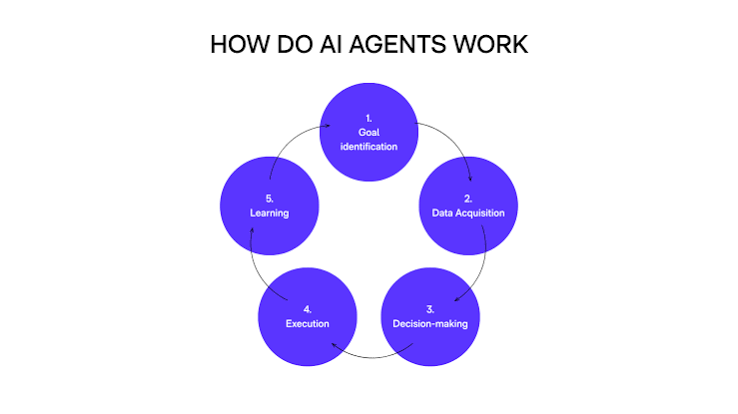
The easiest way to understand an AI agent is as a continuous loop.
Goal → Understand → Plan → Act → Observe → Adjust → Complete
For example, imagine an agent is asked:
“Find three suitable software options and prepare a comparison.”
The agent could:
- Interpret the request.
- Determine what information is needed.
- Search available sources.
- Collect relevant information.
- Compare the options.
- Identify missing information.
- Produce a structured result.
A simple chatbot might provide an answer immediately.
An agentic system can instead perform a sequence of actions.
Read More: What Is Generative AI? How It Works and Where It Is Used
The Main Components of an AI Agent
1. AI Model
The underlying model provides the intelligence used to understand instructions, reason about information, and generate decisions or actions.
Large language models are commonly used for agents that work with natural language.
2. Goal or Instructions
The agent needs to know what it is supposed to accomplish.
A goal could be:
- Answer customer questions
- Analyze a document
- Research a topic
- Fix a software issue
- Schedule an appointment
- Process an internal request
Clear instructions help constrain the agent’s behavior.
3. Tools
Tools allow an AI agent to interact with external systems.
Depending on the application, tools may include:
- Web search
- Databases
- APIs
- Calculators
- Code execution
- Email systems
- Calendars
- CRM platforms
- File storage
- Business software
This is one of the biggest differences between a model that only generates text and an agent that can perform actions.
4. Memory and Context
An agent may need information from earlier steps.
For example, a research agent might remember:
- What question it is investigating
- Which sources it already checked
- What information it found
- Which questions remain unanswered
Memory can be temporary within a task or persistent across interactions, depending on the system.
5. Planning
An agent may break a large objective into smaller actions.
For example:
Goal: Prepare a market report.
Possible plan:
Research → Collect sources → Extract information → Analyze → Structure → Draft → Review
Planning does not always happen as one fixed sequence. An agent may change its approach after seeing the result of an action.
6. Feedback
Agents need information about what happened after an action.
For example:
Agent: Search for a document.
System: Document found.
Agent: Read the document.
System: Relevant information extracted.
Agent: Compare it with another source.
This feedback loop allows the system to respond to changing conditions.

AI Agent vs Chatbot
The terms are sometimes used interchangeably, but they describe different concepts.
| Chatbot | AI Agent |
|---|---|
| Usually responds to user messages | Can pursue a goal across multiple steps |
| Often conversational | Can be action-oriented |
| May generate text only | Can use external tools |
| Usually waits for another prompt | May continue through a workflow |
| Limited interaction with systems | Can interact with APIs and applications |
| Primarily answer-focused | Task-completion focused |
The distinction is not absolute.
A chatbot can contain agentic capabilities, and an AI agent can communicate through a chat interface.
The important difference is what the system can actually do.
AI Agents vs Generative AI
Generative AI is the broader technology category concerned with producing new content.
An AI agent is an application or system that can use AI models to pursue objectives and take actions.
A useful way to think about the relationship is:
Generative AI model = intelligence
Tools = capabilities
Agent = system coordinating intelligence and capabilities toward a goal
An agent may use a generative AI model, but not every generative AI application is an agent.
For example, an image generator creates an image from a prompt.
An AI marketing agent might research a topic, analyze competitors, draft content, check requirements, and organize the result.
A Simple Example of an AI Agent
Imagine a company creates a customer-support agent.
A customer writes:
“My order arrived damaged. What can I do?”
The agent could potentially:
- Identify the customer’s issue.
- Look up the order.
- Check the company’s return policy.
- Determine whether the order qualifies.
- Create a support request.
- Provide the customer with next steps.
A traditional chatbot might simply explain the return policy.
An agent can potentially connect the policy to the customer’s actual order and perform authorized actions.
What Are AI Agents Used For?
AI agents can be applied to many types of workflows.
AI Agents in Customer Service
Customer support is a natural application for agentic systems.
An agent can potentially:
- Answer common questions
- Search a knowledge base
- Check account information
- Classify requests
- Create tickets
- Escalate complex cases
- Provide status updates
The agent should operate within clearly defined permissions.
For sensitive situations, human review may be required.
AI Agents in Software Development
Software engineering is another major application.
A coding agent can potentially:
- Inspect a codebase
- Understand an issue
- Search relevant files
- Modify code
- Run tests
- Analyze errors
- Make additional changes
- Prepare a final patch
This is different from asking an AI chatbot:
“Write a Python function that sorts a list.”
The coding agent is working toward a larger software-development objective.
AI Agents for Research
Research agents can automate parts of information gathering.
A research workflow could look like:
Research question
↓
Search sources
↓
Collect relevant information
↓
Compare sources
↓
Identify gaps
↓
Produce structured findings
This can be useful for:
- Market research
- Competitor analysis
- Technical research
- Literature discovery
- Business intelligence
Human verification remains important because an agent can misunderstand sources or select unreliable information.
AI Agents in Business Operations
Businesses can use agents to coordinate repetitive workflows.
Examples include:
- Processing forms
- Classifying emails
- Updating records
- Preparing reports
- Managing internal requests
- Monitoring workflows
- Generating summaries
The key benefit is that an agent can connect multiple steps that would otherwise require manual work.
AI Agents in Sales and Marketing
Marketing and sales teams can use agents for tasks such as:
- Lead research
- Customer segmentation
- Content planning
- Competitor monitoring
- Email drafting
- CRM updates
- Campaign analysis
For example, an agent might identify a new lead, research publicly available company information, prepare a summary, and place the information into a CRM.
Whether the agent should automatically contact the lead is a separate question involving quality, permissions, and business policy.
AI Agents in Personal Productivity
Personal AI agents can potentially assist with:
- Scheduling
- Email organization
- Task management
- Research
- Travel planning
- Document organization
- Reminders
- Information retrieval
The more external access an agent receives, the more important permission and security controls become.
What Makes an AI Agent “Agentic”?
The word agentic generally refers to a system’s ability to pursue objectives through actions rather than simply producing a single response.
Common agentic characteristics include:
Goal-oriented behavior
The system works toward an objective.
Multi-step execution
The task may involve several actions.
Tool use
The system can interact with external tools.
Adaptation
The agent can adjust its approach based on results.
Autonomy
The system can perform some actions without requiring a human to approve every individual step.
These characteristics exist on a spectrum.
Not every AI system with a tool call should automatically be considered a highly autonomous agent.
What Is an AI Agent Loop?
A common conceptual model is the agent loop.
Step 1: Receive the Goal
The user or system provides an objective.
Step 2: Interpret the Goal
The AI determines what the task requires.
Step 3: Plan
The system identifies possible actions.
Step 4: Choose an Action
It selects a tool or operation.
Step 5: Execute
The action is performed.
Step 6: Observe
The system receives the result.
Step 7: Evaluate
The agent determines whether it has enough information.
Step 8: Continue or Finish
It either takes another action or produces the final result.
This cycle can repeat several times.
Why Tool Use Matters
An AI model by itself has limited ability to change the outside world.
Tool access changes that.
Consider the difference:
Without tools:
“Here is how you could create a calendar event.”
With a calendar tool:
“I created the calendar event.”
The second system is more action-oriented because it can interact with an external service.
This is why APIs and tool integrations are central to many agentic systems.
AI Agents and APIs
An API, or application programming interface, allows software systems to communicate.
An AI agent can use APIs to interact with other applications.
For example:
AI agent → weather API → current weather
AI agent → calendar API → available times
AI agent → database API → customer record
AI agent → payment system → authorized transaction
The agent’s usefulness therefore depends not only on the AI model but also on the tools and APIs available to it.
Memory in AI Agents
Memory can make an agent more useful for longer workflows.
There are several forms of memory.
Short-Term Context
Information available during the current task.
Long-Term Memory
Information stored for possible use in future interactions.
External Memory
Information retrieved from databases, documents, knowledge bases, or other systems.
Memory must be carefully designed because retaining unnecessary or sensitive information can create privacy and security risks.
AI Agent Safety and Permissions
Giving an AI the ability to take actions introduces risks that do not exist when it only generates text.
Imagine an agent with permission to:
- Send emails
- Delete files
- Purchase products
- Change account settings
- Modify databases
A mistake could have real consequences.
For this reason, responsible agent systems can use controls such as:
- Limited permissions
- Approval requirements
- Tool restrictions
- Audit logs
- Sandboxed environments
- Spending limits
- Human escalation
- Confirmation before sensitive actions
The principle is simple:
The more power an agent has, the stronger its controls should be.
Common Problems With AI Agents
AI agents can be useful, but they are not guaranteed to complete tasks correctly.
Hallucinations
An agent may generate incorrect information and then use that information in later steps.
Wrong Tool Selection
The system may choose an inappropriate tool or action.
Planning Errors
A poor initial plan can send the entire workflow in the wrong direction.
Infinite or Unnecessary Loops
An agent can sometimes repeat actions without making useful progress.
Permission Problems
An agent with excessive access can cause greater damage when something goes wrong.
Prompt Injection
If an agent reads untrusted external content, malicious instructions embedded in that content can potentially influence its behavior.
This is particularly important for agents that browse websites, read emails, process documents, or interact with external systems.
AI Agents vs Automation
Traditional automation and AI agents are related but different.
Traditional automation usually follows predefined rules.
For example:
If an order is received → send confirmation email.
An AI agent may handle a less predictable process:
Review the customer request → understand the issue → search relevant information → determine the appropriate workflow → take an authorized action.
Traditional automation is often more predictable.
AI agents are potentially more flexible.
A strong business system may use both.
Are AI Agents Fully Autonomous?
Usually, autonomy is a matter of degree.
An agent might:
- Suggest an action
- Ask for approval
- Perform low-risk actions automatically
- Complete a predefined workflow independently
- Operate continuously under strict rules
A useful design principle is to match autonomy to risk.
For a low-risk task, automatic execution may be acceptable.
For a financial transaction or sensitive business decision, human approval may be appropriate.
How AI Agents Can Improve Productivity
The biggest potential benefit is not simply generating information faster.
It is reducing the number of manual steps required to complete a task.
For example, consider a weekly report.
Without an agent:
Open database → export data → clean spreadsheet → calculate results → write summary → send email
With a properly configured agent:
Start report workflow → agent gathers approved data → analyzes it → prepares summary → requests approval → sends report
The human remains responsible for reviewing important results while the agent handles repetitive coordination.
What Is the Future of AI Agents?
AI development is increasingly moving toward systems that can interact with tools and complete multi-step tasks.
Future agentic systems may combine:
- Large AI models
- Search
- Computer-use capabilities
- APIs
- Databases
- Memory
- Business software
- Coding environments
- Robotics
This could make AI more useful as an operational layer between people and software.
However, greater autonomy also means greater responsibility.
The most successful AI agents will need to be not only capable, but also reliable, controllable, observable, and secure.
How to Start Using AI Agents
If you want to introduce agents into a business or personal workflow, start small.
Step 1: Choose a Repetitive Task
Look for a workflow with predictable inputs and measurable results.
Step 2: Define the Goal
Describe exactly what the agent should accomplish.
Step 3: Limit Its Permissions
Only give access to the tools it actually needs.
Step 4: Add Human Approval
Require confirmation for sensitive or irreversible actions.
Step 5: Test With Real Examples
Run the workflow with representative tasks before allowing broad automation.
Step 6: Monitor Results
Track errors, failures, unnecessary actions, and successful completions.
Step 7: Expand Gradually
Only increase autonomy after the system performs reliably within its current boundaries.
Frequently Asked Questions
What is an AI agent in simple terms?
An AI agent is a software system that can pursue a goal by understanding instructions, planning steps, using tools, observing results, and taking additional actions when necessary.
What is the difference between an AI agent and a chatbot?
A chatbot generally focuses on conversation and responding to prompts. An AI agent can go beyond conversation by using tools and completing multi-step tasks.
Are AI agents the same as generative AI?
No. Generative AI creates content, while an AI agent is a system that can use AI models, tools, and workflows to pursue an objective. An agent can use generative AI as part of its architecture.
What are AI agents used for?
AI agents can support customer service, software development, research, business operations, marketing, sales, scheduling, data processing, and other multi-step workflows.
Can AI agents make decisions?
They can make decisions within the rules, tools, and permissions given to them. However, sensitive decisions may require human approval and oversight.
Are AI agents safe?
AI agents can be made safer through restricted permissions, monitoring, approval steps, sandboxing, and other controls. However, giving an AI system the ability to take real-world actions introduces additional risks.
Can AI agents replace human workers?
AI agents can automate parts of some jobs and reduce manual work, but whether they can replace an entire role depends on the complexity, risk, creativity, and human interaction involved.
How do AI agents use tools?
Agents can use APIs, databases, search systems, calendars, software applications, code execution environments, and other tools to perform actions outside the AI model itself.
Conclusion
AI agents represent a shift from AI that simply generates responses toward AI systems that can pursue goals and perform multi-step tasks. They combine an AI model with instructions, tools, context, planning, and feedback to interact with software and complete defined workflows.

1 Comment
Pingback: Best Productivity Apps 2026 That Can Actually Save You Time