


Solid-State Batteries are the most talked-about battery breakthrough of 2026, and they are also one of the most misunderstood. They promise longer range, faster charging, and a safer cell than the lithium-ion batteries inside almost every electric car, phone, and laptop today. Yet headlines often make it sound as if solid-state cars and phones are already on sale everywhere, when the honest picture is more useful: pilot lines are running, test cars are driving, a bridge technology called semi-solid is already reaching some buyers in China, and true large-scale production is still a few years away.
This guide explains Solid-State Batteries in plain language: how they work, how the three main electrolyte types compare, what leading makers have actually announced versus actually shipped, and what it all means for your next car, phone, or laptop. Every date below is labelled as a target, a pilot stage, or a test result, because targets vary by maker and several have already slipped once before.
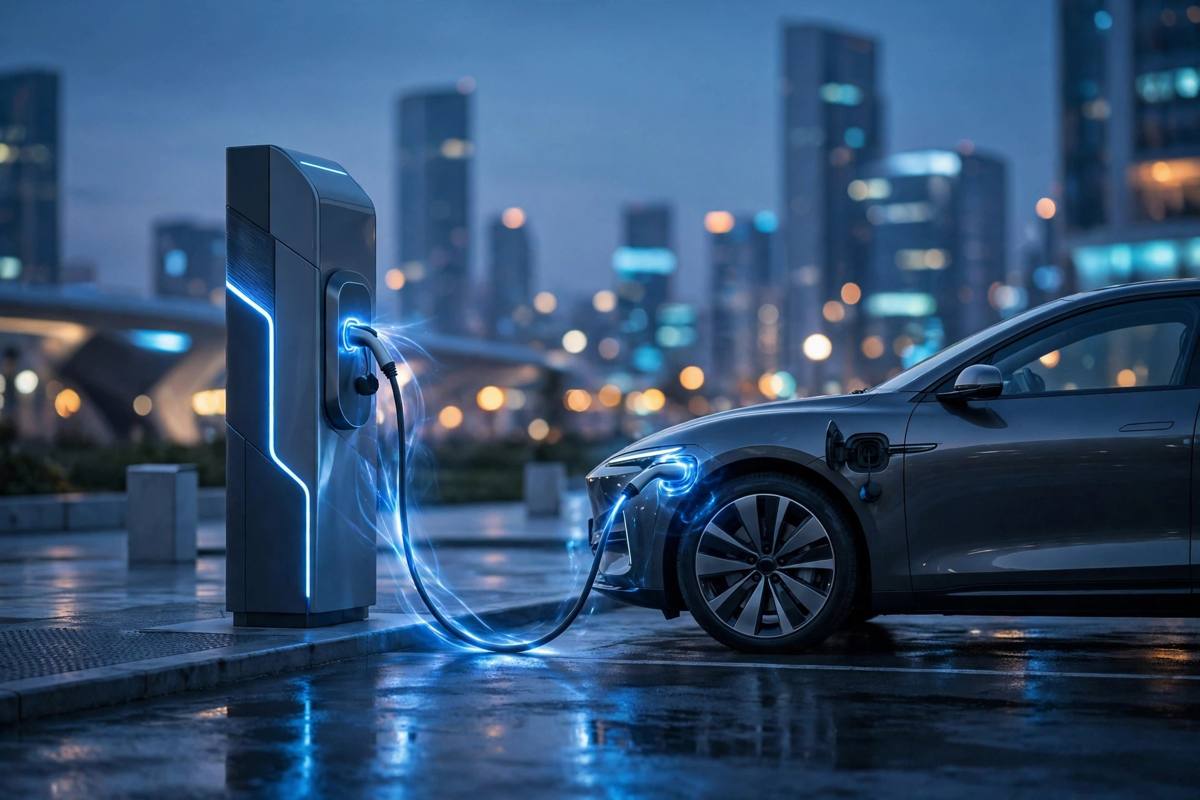
The short version is this: solid-state technology is real and progressing, and it could reshape electric cars first, then premium phones and laptops, then aviation. It will not replace lithium-ion overnight. Change will arrive in stages, starting with expensive, limited models and moving to everyday products only as cost and manufacturing yield improve.
What Solid-State Batteries Actually Are
A solid-state battery replaces the liquid electrolyte of a conventional lithium-ion cell with a solid material. In a lithium-ion cell, a flammable liquid carries lithium ions between the electrodes. In a solid-state cell, that job is done by a solid sulfide, ceramic, or polymer electrolyte.
That single change matters because the electrolyte touches every part of the cell. A solid electrolyte can, in principle, allow a lithium-metal anode, tolerate higher voltages, and remove the flammable liquid behind many of today’s pack safety systems. Note that solid-state covers a family of designs, not one identical product, so always ask which electrolyte type a claim refers to.
- Anode: the negative electrode, where lithium is stored during charging.
- Cathode: the positive electrode, which largely sets voltage and capacity.
- Electrolyte: the medium lithium ions travel through between anode and cathode.
Those battery-life trade-offs also shape everyday gadgets, as the best budget smartphones and how battery life varies across price ranges show.
How Solid-State Batteries Work in Plain Language
Charging and discharging follow the same basic idea as lithium-ion: lithium ions move from one electrode to the other, while electrons travel through the outside circuit to power a motor or screen. The difference is the road the ions travel on. The journey runs like this:
Cathode releases lithium ions → Ions cross the solid electrolyte → Ions arrive at the anode and are stored → Electrons flow through the external circuit → On discharge, the whole process runs in reverse.
Step 1: Charging Moves Ions to the Anode
When you plug in, energy pushes lithium ions out of the cathode, across the solid electrolyte, and into the anode. In many designs the anode is lithium metal itself, which is why these cells can store more energy in the same space.
Step 2: The Solid Layer Keeps Electrodes Apart
The solid electrolyte must let ions through quickly while keeping electrodes from touching. If it is too thick, ions move slowly. If it is cracked, the cell can short. Much of the engineering effort in 2026 is making this layer thin, uniform, and durable at factory scale.
Step 3: Discharging Reverses the Flow
When you drive, stream, or type, ions flow back to the cathode and electrons flow through your device.
Solid-State Batteries vs Lithium-Ion Batteries
Today’s lithium-ion batteries are mature, affordable, and made at enormous scale. Typical lithium-ion cells sit around 250 to 300 watt-hours per kilogram, with lithium iron phosphate designs lower and high-nickel designs higher. They charge well, last years in most cars and phones, and their price has fallen sharply over the past decade.
Solid-state pilot cells aim higher, often around 350 to 500 watt-hours per kilogram, with Toyota pilot-line sulfide cells reported at around 844 to 900 watt-hours per litre and QuantumScape QSE-5 cells at around 844 watt-hours per litre. Those are pilot figures, not showroom specifications, and the table below keeps that distinction clear.
| Feature | Lithium-Ion Today | Solid-State Pilot Cells |
|---|---|---|
| Electrolyte | Flammable liquid solvent | Solid sulfide, ceramic, or polymer |
| Typical energy density | Around 250 to 300 Wh/kg | Around 350 to 500 Wh/kg in pilot cells |
| Fast-charge target | About 20 to 40 minutes, 10 to 80 percent | About 10 to 15 minutes, 10 to 80 percent, as a target |
| Safety profile | Needs venting, cooling, fire containment | No liquid fuel load, but still needs pack safety engineering |
| Cost today | Mass-production pricing | Several times lithium-ion cost at pilot scale |
| Availability | On sale in millions of products | Pilot lines, samples, test vehicles |
The table does not claim solid-state cells already last longer in real cars, because cycle-life results vary widely and automotive qualification takes years. It says they are denser and potentially faster and safer, and those advantages still have to survive the journey from pilot line to affordable mass production.
Read More: Smartphone Trends 2026: What Is Changing and Why It Matters
Sulfide Solid-State Batteries Explained
Sulfide electrolytes are the leading choice for automotive programs, including Toyota and Samsung SDI. Their main advantage is ionic conductivity: lithium ions move through sulfide materials quickly, which supports fast charging and high power. Sulfide cells can also be pressed into large-format car cells.
The drawbacks are serious. Sulfide materials are sensitive to moisture and air, so factories need very dry, tightly controlled conditions. They can also react at electrode interfaces, raising resistance over time unless coatings and careful design are used. Manufacturing yield, the share of cells passing quality checks, is one of the main gates between a working pilot line and a profitable factory.
- Best for: electric vehicles where fast charging matters.
- Key strength: high ionic conductivity and fast-charge potential.
- Key weakness: air sensitivity and demanding factory conditions.
Ceramic Solid-State Batteries Explained
Ceramic electrolytes, often oxide-based, are hard, stable materials that can physically block dendrites, the tiny lithium filaments that can short a cell. QuantumScape is the best-known example, with an anode-free lithium-metal design built around a ceramic separator. Its QSE-5 cells, reported at around 844 watt-hours per litre, have reached B-sample shipments to automotive partners, meaning larger, more representative samples for testing rather than small laboratory cells.
Ceramics bring a mechanical problem: a rigid layer must stay in intimate contact with electrodes that expand and contract as they cycle. If contact is lost, resistance rises and performance falls. Makers address this with pressure, coatings, and stack design, but keeping contact perfect across thousands of cycles in a vibrating car is a genuine challenge.
- Best for: premium electric vehicles where safety and density matter most.
- Key strength: chemical stability and dendrite-blocking structure.
- Key weakness: brittle interfaces and contact loss over cycling.
Polymer Solid-State Batteries Explained
Polymer electrolytes use a soft, plastic-like material to carry ions. A flexible film can keep better contact with electrodes as they move, and polymer designs have appeared in smaller and niche products for years. They remain relevant for wearables, medical devices, and other small-format uses.
The trade-off is conductivity. Many polymer electrolytes conduct ions more slowly, especially at room temperature, which can limit fast charging and high power unless the cell is heated or specially engineered. Hybrid designs mixing polymer with ceramic fillers try to keep flexibility while improving conductivity and stability.
- Best for: small devices, flexible formats, lower-power uses.
- Key strength: good electrode contact and easier processing.
- Key weakness: lower ionic conductivity at normal temperatures.
Solid-State Battery Energy Density Explained
Energy density is quoted two ways, and confusing them is an easy way to misread a claim. Gravimetric density, in watt-hours per kilogram, tells you how much energy a battery holds for its weight. Volumetric density, in watt-hours per litre, tells you how much it holds for its size. Weight matters most in cars and aircraft; size matters most in phones and laptops.
- Lithium-ion today: typically around 250 to 300 Wh/kg at cell level.
- Semi-solid bridge cells: around 300 to 360 Wh/kg in some Chinese electric vehicles.
- Solid-state pilot targets: around 400 to 500 Wh/kg for automotive programs.
- Volumetric pilot figures: around 844 to 900 Wh/L for leading sulfide and ceramic pilot cells.
Solid-State Battery Charging Speed Explained
Toyota has stated a fast-charge target of around 10 minutes, generally understood as roughly 10 to 80 percent charge. QuantumScape has reported around 12 minutes for a similar window. These are targets and test results, not a guarantee that every future solid-state car will charge that fast on every public charger.
Solid-State Battery Safety Explained
Safety is where solid-state batteries have a genuine structural advantage. A conventional lithium-ion cell contains a flammable liquid, and if damaged, overheated, or shorted, that liquid can feed thermal runaway. Carmakers manage this with strong pack structures, cooling, venting, and software limits, and modern electric cars are statistically safe, but the safety engineering adds weight, cost, and complexity.
Removing the flammable liquid removes one major fuel source, and several makers report passing nail-penetration and heat tests that would be far more dangerous for a liquid cell. That does not make a solid-state pack invulnerable. Lithium metal, high voltages, and manufacturing defects still need careful pack design, testing, and certification.
Solid-State Battery Lifespan Explained
Lifespan is the least settled part of the solid-state story, so bold cycle-life claims deserve caution. Published results vary enormously by design, test conditions, pressure, temperature, and how cycle life is defined. Some laboratory cells report over 1,000 cycles at high capacity retention, while other designs degrade faster outside carefully controlled tests.
- Calendar ageing: capacity lost over time even when unused.
- Cycle ageing: capacity lost through repeated charging.
- Interface ageing: resistance growth where electrolyte meets electrodes.
Semi-Solid Batteries: The Bridge Technology
If all-solid-state batteries are the destination, semi-solid batteries are the bridge already carrying traffic. A semi-solid cell keeps a small amount of liquid, typically around 5 to 15 percent, alongside a solid or gel component. That liquid helps ions move and keeps electrodes in good contact, solving some of the hardest solid-solid interface problems, at the cost of keeping some liquid-cell limits.
This compromise is already on the road in China. Nio offers a 150 kilowatt-hour semi-solid pack, developed with WeLion, reported at around 360 watt-hours per kilogram at cell level. IM Motors, part of SAIC, offers semi-solid packs in its L6 sedan at over 300 watt-hours per kilogram, with claimed range beyond 1,000 kilometres on Chinese test cycles. These are real customer cars, not test mules, but they are not all-solid-state cars, and honest reporting should never blur that line.
Solid-State Batteries Maker Timeline for 2026 to 2030
Timelines are where solid-state reporting most often goes wrong, because a target date gets repeated until it sounds like a delivery date. The table below labels each maker’s status honestly: pilot, sample, test vehicle, or target. Targets vary by maker because chemistries, partners, and factory readiness differ.
| Maker and Partner | Electrolyte Type | Status in 2026 | Stated Target |
|---|---|---|---|
| Toyota with Idemitsu Kosan | Sulfide | Pilot line, cells reported at 844 to 900 Wh/L | Lexus EV targeted for 2027 to 2028 |
| Samsung SDI | Sulfide | Pilot line, 500 Wh/kg-class cells | Qualification targeted 2027, mass production targeted H2 2027 |
| QuantumScape with Volkswagen PowerCo | Ceramic separator, anode-free lithium metal | QSE-5 cells in B-sample shipments | No public passenger-car launch date |
| Nissan | All-solid-state | Pilot line in Yokohama | First EV targeted for fiscal 2028 |
| CATL | All-solid-state and semi-solid | Pilot production, small batches discussed | Small batches targeted 2027, larger scale later |
| Solid Power with BMW | Sulfide | Pilot cells in BMW i7 test vehicle | Qualification targeted 2027 to 2028, production unconfirmed |
Read the table across and the pattern is clear: nobody is at mass production yet. Industry consensus places large-scale commercialization closer to 2028 to 2030, with limited, premium models possibly earlier.
Solid-State Batteries for Electric Vehicles
Electric vehicles are the natural first market for solid-state batteries, because cars benefit from every advantage at once: higher density means longer range or a lighter car, faster charging means shorter stops, and better safety means simpler pack protection. Premium buyers will also tolerate higher early prices, which matters while costs remain well above lithium-ion.
The first solid-state cars will probably not be cheap family cars. They will be flagship sedans and SUVs where a longer range figure justifies a premium price and the maker can monitor a small fleet closely. For today’s buyer, the practical takeaway is simple: buy the best lithium-ion car that fits your needs now, and treat solid-state as a reason to consider a shorter lease or later upgrade, not a reason to wait indefinitely.
Solid-State Batteries for Phones
Phones are where solid-state hype most often outruns reality. No mass-market phone you can buy in 2026 runs on an all-solid-state battery. Phones are small, thin, price-sensitive, and produced in hundreds of millions of units, making them one of the hardest places to introduce an expensive, pilot-stage chemistry.
That does not mean phones will never benefit. A denser cell could eventually mean a thinner phone with the same battery life, or the same phone with two days of use. But phones will likely follow cars, not lead them, because car makers can absorb early costs and volumes that phone makers cannot. If you are comparing phones today, capacity, charging speed, and software efficiency matter far more than any solid-state label.
Solid-State Batteries for Laptops
Laptops sit between cars and phones. They need more energy than a phone but far less than a car, and buyers care deeply about weight, thickness, and all-day battery life. A denser cell could let a thin ultrabook run longer, or let a powerful creator laptop stay portable without a heavy battery.
Laptops also tolerate higher prices better than budget phones, especially in premium and business ranges, making them a plausible early consumer market after cars. For now, judge laptop battery life by tested hours, not chemistry labels: a well-optimized lithium-ion laptop with an efficient chip will beat a poorly optimized machine on any chemistry. Solid-state will matter when it ships in a named model with independent battery tests.
Solid-State Batteries for Aviation and Other Uses
Aviation is one of the most exciting long-term uses, because aircraft care more about weight than almost any other vehicle. Electric short-haul flights, air taxis, and drones all need maximum energy for minimum weight and benefit from safer cells. Aviation certification is slower and stricter than car qualification, though, so this market will take longer.
Solid-State Battery Challenges in 2026
Four challenges explain why solid-state batteries are not yet in mass production, and a breakthrough solving only one of them is not the same as a production-ready battery.
Challenge 1: Keeping Solid Surfaces in Contact
Two solid materials meet at a flat, stiff interface, unlike a liquid that flows into every pore. As electrodes expand and contract, contact can weaken, resistance rises, and performance falls. Coatings, pressure systems, and flexible layers help, but they must survive thousands of cycles.
Challenge 2: Stopping Dendrites
Dendrites are tiny, needle-like lithium growths that can pierce a separator and short a cell. Solid electrolytes are meant to block them, but defects, cracks, and uneven current can still let them grow. Dense, defect-free layers and uniform current distribution are essential.
Challenge 3: Surviving Temperature and Pressure
Many solid-state cells perform best under specific pressure and temperature conditions that are easy to maintain in a lab and harder in a car. Packs must hold the right pressure across vibration, ageing, and temperature swings without adding excessive weight.
Challenge 4: Scaling Without Defects
A hand-made laboratory cell can be perfect. A factory must make millions of cells with the same quality, in dry rooms, at high speed, with very few rejects. Yield, not chemistry alone, often decides whether a battery can be sold at a viable price.
Solid-State Battery Cost and Manufacturing Problems
Cost is the bluntest solid-state problem. At pilot scale, solid-state cells cost several times as much per kilowatt-hour as mass-produced lithium-ion cells. Some published estimates put early solid-state costs in the hundreds of dollars per kilowatt-hour, against roughly 80 to 100 dollars for mature lithium-ion packs. Figures vary by source and design, but the direction is consistent: solid-state is expensive today.
Manufacturing explains much of the gap. Sulfide electrolytes need dry, air-free handling. Ceramic layers need defect-free production. New factories need new equipment, quality checks, and supply chains for materials lithium-ion factories do not use at scale. Costs should fall as production grows, just as lithium-ion costs fell, but Nissan’s discussed targets around 75 dollars per kilowatt-hour at launch, falling toward 65 dollars, are targets for a future production stage, not today’s prices.
Should You Wait for Solid-State Batteries in 2026
The honest answer depends on what you are buying and when you need it. If you need a car, phone, or laptop now, buy now. Solid-state models are not available at mass-market prices, and waiting for an unconfirmed launch date means missing years of use from a good lithium-ion product.
If you are buying at the premium end and can wait a year or two, the calculation changes slightly. A flagship car buyer in late 2027 or 2028 may genuinely face a choice between a proven lithium-ion model and an early solid-state model. Even then, compare tested range, charging, warranty, and price, not a chemistry label. Leasing can be a useful middle path for cars, letting you enjoy a current model while keeping the option to switch when solid-state models actually ship.
- Buy now if: you need the product or want proven value.
- Consider waiting if: your current product still works and you shop premium in 2027 or later.
- Never wait indefinitely for: a technology with no named model, price, or ship date.
Solid-State Battery Myths vs Reality
Myth: Solid-state batteries are already in mass production. Reality: pilot lines, samples, and test vehicles are running, but large-scale all-solid-state production is targeted closer to 2028 to 2030, with limited models possibly earlier.
Myth: You can buy a solid-state phone today. Reality: no mass-market phone ships with an all-solid-state battery. Semi-solid packs exist in some Chinese cars, a different technology stage.
Myth: Solid-state batteries never catch fire. Reality: they remove the flammable liquid, which lowers risk, but lithium-metal cells still need proper pack engineering, testing, and certification.
Myth: Every solid-state car will charge in 10 minutes. Reality: 10 minutes is a stated target for certain designs under certain conditions, not a universal specification.
Myth: Lithium-ion is finished. Reality: lithium-ion keeps improving, especially with silicon anodes and better pack design, and it will remain mainstream for years.
Solid-State Battery Buying Checklist for 2026
Use this checklist whenever a seller or advertisement mentions solid-state batteries. If a claim cannot pass these checks, treat it as marketing until a named product proves otherwise.
- Is a specific maker and model named, or only a technology in general?
- Is the electrolyte type stated: sulfide, ceramic, polymer, or semi-solid?
- Are dates labelled as targets, pilot stages, or shipped products?
- Are density figures given in Wh/kg or Wh/L, and at cell or pack level?
- Is charging time quoted with a percentage window, such as 10 to 80 percent?
- Has an independent test, not just a company claim, verified the result?
- Is there a price, warranty, and availability date, or only a roadmap?
- Does the description confuse semi-solid with all-solid-state?
Solid-State Batteries replace a liquid with a solid, and that change unlocks real gains in density, charging, and safety. The path from pilot line to your driveway or pocket runs through cost, yield, durability testing, and certification, and that path takes years. Knowing where each maker stands on that path is what turns excitement into smart buying.
To learn more about how the technology itself is defined and classified, see the solid-state battery overview on Wikipedia.
Frequently Asked Questions About Solid-State Batteries
What is a solid-state battery in simple terms?
It is a rechargeable battery that uses a solid electrolyte instead of a liquid one to carry lithium ions between electrodes. That change can allow higher energy density, faster charging, and a safer cell design, once manufacturing at scale is solved.
Are solid-state batteries available to buy in 2026?
Not as mass-market all-solid-state products. Pilot lines and test vehicles are running, and semi-solid packs are already in some Chinese electric vehicles, but large-scale all-solid-state production is still targeted for closer to 2028 to 2030.
How much longer will a solid-state electric car go on one charge?
Targets vary by maker, but premium models aim for substantially longer range than today’s typical electric cars, with some targets around 600 miles or more. Real range will depend on pack size, vehicle weight, driving conditions, and whether the maker trades density for a lighter pack.
Will solid-state batteries charge in 10 minutes?
Ten minutes is a stated target for certain designs, usually for roughly 10 to 80 percent charge under favourable conditions. Real charging time will also depend on the charger, cooling, temperature, and battery condition, so treat 10 minutes as a goal, not a guaranteed stop time.
Are solid-state batteries safer than lithium-ion batteries?
They have a structural safety advantage because they remove the flammable liquid electrolyte. That lowers thermal-runaway risk, but it does not remove the need for careful pack design, quality control, and certification.
Should I wait for a solid-state phone or laptop?
No, not in 2026. No mass-market phone or laptop ships with an all-solid-state battery yet. Buy based on tested battery life, charging, and price today, and revisit solid-state when a named model ships with verified specifications.
Conclusion
Solid-State Batteries in 2026 are best understood as a technology in transition: proven in pilot lines, promising in test vehicles, partly previewed through semi-solid cars in China, and still working toward affordable mass production. Toyota, Samsung SDI, QuantumScape, Nissan, CATL, and Solid Power have each reached a different point on that road, and their targets vary, which is why honest labelling of pilot versus target matters so much.
The gains are real enough to matter. Higher density, faster charging, and a safer starting point could reshape electric cars first, then premium phones, laptops, and aircraft. The barriers are equally real: cost, manufacturing yield, interface durability, and years of automotive qualification. Neither side of that story should be exaggerated.
For buyers in 2026, the smart move is clear. Enjoy the excellent lithium-ion products available now, use the checklist in this guide to judge every solid-state claim, and watch for named models with tested specifications rather than vague promises. When solid-state batteries do reach your next car, phone, or laptop, you will recognise a genuine product because it will come with a name, a price, a warranty, and independent test results. Until then, the most useful thing this technology can give you is a better way to read the headlines about it.
