
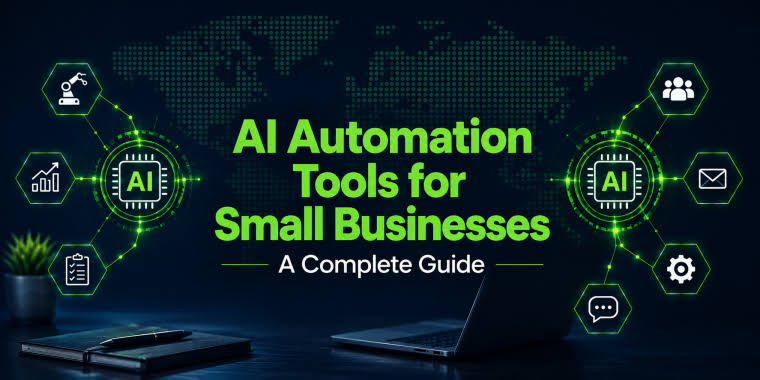
The Best AI Tools for Small Business Automation in 2026 combine artificial intelligence with practical automation. They can help businesses capture leads, respond to customers, manage projects, create marketing content, process documents, and connect different applications. This guide compares the strongest options by use case, explains what each tool does, and shows how to build a practical AI automation stack.
Running a small business often means managing sales, marketing, customer support, accounting, content, and daily administration at the same time. AI automation can reduce repetitive work by connecting business apps, generating content, organizing information, and handling routine workflows. The challenge is choosing tools that deliver real value instead of adding another complicated subscription.
What Is AI Automation for Small Businesses?
AI automation combines artificial intelligence with software workflows to complete tasks that would otherwise require manual effort.
Traditional automation usually follows predefined rules:
When X happens → do Y.
AI automation can add another layer:
When X happens → understand the information → make a decision or generate content → perform the next action.
For example, a traditional workflow might automatically send an email when someone fills out a contact form.
An AI-powered workflow could:
- Receive the form submission.
- Read the customer’s message.
- Identify what the person needs.
- Classify the lead.
- Summarize the request.
- Add information to a CRM.
- Draft a personalized response.
- Notify the appropriate employee.
This distinction makes AI automation particularly useful for small businesses with limited staff.
Recent 2026 automation guides increasingly emphasize connecting AI with existing business applications rather than treating AI as a standalone chatbot.
Read More: AI Search Engines vs Google: What’s the Real Difference?
Best AI Tools for Small Business Automation in 2026
The best tool depends on the problem you want to solve. There is no single application that is perfect for every business.
| AI Tool | Best For | Main Strength |
|---|---|---|
| ChatGPT | General business tasks | Writing, research, analysis, brainstorming |
| Zapier | Workflow automation | Connecting apps and automating processes |
| Microsoft 365 Copilot | Microsoft-based businesses | AI inside Microsoft 365 workflows |
| HubSpot | Sales and CRM | Lead management and customer workflows |
| Canva | Marketing and design | AI-assisted visual content |
| QuickBooks | Accounting | Financial organization and automation |
| Notion | Knowledge and project management | AI-powered workspace |
| Google Workspace with Gemini | Office productivity | AI inside Google productivity tools |
| Fireflies.ai | Meetings | Transcription and meeting summaries |
| Power Automate | Microsoft workflow automation | Business process automation |
These tools serve different purposes, so businesses should select them according to their workflow rather than trying to install every popular AI application.
1. ChatGPT — Best All-Purpose AI Assistant
OpenAI’s ChatGPT is useful for a broad range of small-business tasks.
It can help with:
- Email drafting
- Content creation
- Brainstorming
- Research
- Data analysis
- Document summarization
- Customer-response drafts
- Business planning
- Coding
- Creating templates
OpenAI launched a dedicated small-business program in 2026 focused on helping entrepreneurs use ChatGPT in everyday business operations.
ChatGPT is especially useful when your business needs a flexible AI assistant rather than a tool dedicated to one department.
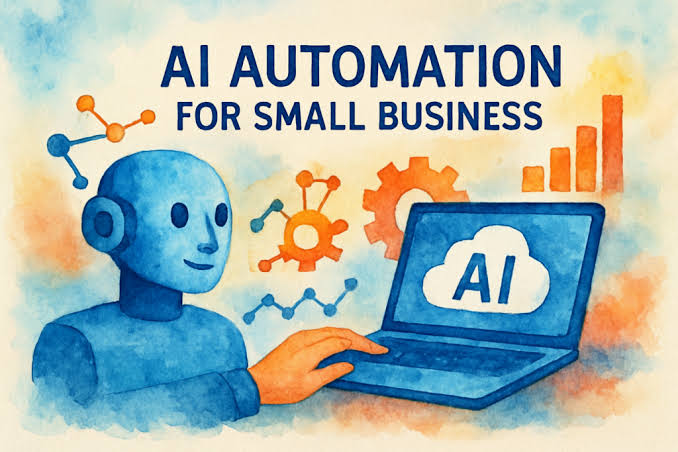
Example Automation
A small marketing agency could use AI to:
Client notes → summarize requirements → create content brief → draft social posts → generate review checklist
Human review should remain part of the process, particularly for client-facing or sensitive work.
Best for: Solo business owners, agencies, consultants, freelancers, and small teams.
2. Zapier — Best for Connecting Business Apps
Zapier is one of the strongest choices when your goal is actual workflow automation.
Zapier connects business applications so that actions in one application can trigger actions in another.
Its 2026 small-business guide highlights workflow automation across thousands of applications and AI-powered workflow steps.
Common examples include:
Website form → CRM → email → Slack notification
or:
New sale → invoice → project task → customer email
Zapier also provides AI features that can help create workflows, classify information, summarize messages, and troubleshoot automation problems.
Why Small Businesses Benefit
Instead of hiring someone to repeatedly move information between applications, you can automate the repetitive parts of the process.
Best for: Connecting different business applications.
3. Microsoft 365 Copilot — Best for Microsoft Users
Businesses already using Microsoft 365 may benefit from keeping AI within their existing productivity environment.
Microsoft 365 includes applications such as:
- Outlook
- Word
- Excel
- Teams
- PowerPoint
- OneDrive
AI features can help users work with documents, emails, meetings, spreadsheets, and other workplace tasks.
Microsoft Power Automate can also connect business workflows, while AI-assisted features can help create and manage automation. Zapier’s 2026 automation comparison identifies Power Automate as a strong option for Microsoft-focused organizations.
Example
A team could combine:
Outlook → Power Automate → approval workflow → Teams notification
This can reduce repetitive administrative work.
Best for: Businesses already invested in Microsoft 365.
4. HubSpot — Best for Sales and CRM Automation
HubSpot is useful for businesses that need to manage leads, customers, sales pipelines, and marketing activity.
AI and automation can help with tasks such as:
- Lead management
- Customer communication
- Sales follow-ups
- CRM organization
- Marketing workflows
- Customer support
A simple workflow could look like:
Website visitor → form submission → lead record → qualification → sales task
This reduces the chance that a potential customer gets forgotten.
HubSpot is particularly useful when sales information is scattered across emails, spreadsheets, and messaging applications.
Best for: Sales teams, service businesses, agencies, and growing companies.
5. Canva — Best for AI Marketing Automation
Canva is primarily a design platform, but its AI features can help small businesses produce marketing materials faster.
You can use it for:
- Social media graphics
- Presentations
- Advertisements
- Flyers
- Business documents
- Marketing visuals
- Brand assets
For a small company without a dedicated designer, AI-assisted design can reduce the time needed to create basic marketing materials.
Practical Workflow
Marketing idea → AI-generated copy → Canva design → brand review → social post
The human review step is important because generated designs may still require adjustments for brand consistency.
Best for: Small businesses that create frequent visual content.
6. QuickBooks — Best for Accounting Automation
Intuit QuickBooks is designed around accounting and financial management.
Its AI capabilities can assist with financial tasks and business information.
In 2026, Intuit expanded integrations that allow QuickBooks information and actions to be accessed through Claude and ChatGPT, including sales, invoicing, payroll, and lending-related capabilities.
This illustrates an important direction for business AI: instead of simply asking an AI general questions, businesses can increasingly connect AI with systems where actual work takes place.
Best for: Small businesses that need accounting and financial workflow support.
7. Notion AI — Best for Knowledge Management
Notion combines notes, documentation, project management, and knowledge organization.
AI can be useful for:
- Summarizing documents
- Organizing information
- Creating drafts
- Finding information
- Creating project documentation
- Turning notes into structured content
For example:
Meeting notes → summary → action items → project tasks
This can save employees from manually converting meeting discussions into organized tasks.
Notion is particularly useful when a business has lots of information but struggles to keep it organized.
Best for: Teams managing documents, projects, and internal knowledge.
8. Google Workspace with Gemini — Best for Google Users
Businesses that already rely heavily on Google Workspace can benefit from AI features integrated into their existing productivity environment.
Common applications include:
- Gmail
- Google Docs
- Google Sheets
- Google Meet
- Google Drive
The advantage is convenience.
Instead of moving information into a separate AI application, employees can work with AI within the tools they already use.
A small business might use AI to help:
Email → summarize request → draft response → employee review → send
The employee remains responsible for checking the final communication.
Best for: Businesses using Google Workspace as their primary productivity platform.
9. Fireflies.ai — Best for Meeting Automation
Meetings can create a surprising amount of administrative work.
Employees may need to:
- Take notes
- Write summaries
- Identify action items
- Send follow-up messages
- Update project records
AI meeting assistants such as Fireflies.ai can help automate parts of this process through transcription and summaries.
A typical workflow could be:
Meeting → transcription → summary → action items → follow-up
This can be especially useful for sales calls, team meetings, interviews, and client discussions.
Best for: Businesses that spend significant time in online meetings.
10. Power Automate — Best for Business Process Automation
Microsoft Power Automate is designed for automating workflows across applications and business processes.
It can be particularly useful when a business already operates within the Microsoft ecosystem.
Examples include:
- Automating approvals
- Moving information between applications
- Creating notifications
- Processing documents
- Updating records
- Managing repetitive administrative processes
Zapier’s 2026 automation comparison identifies Power Automate as a strong choice for Microsoft power users.
Best for: Microsoft-centric organizations and structured business workflows.
AI Tools by Business Function
Choosing by job function can make the decision easier.
| Business Need | Recommended Tool Type |
|---|---|
| Writing and brainstorming | ChatGPT |
| Workflow automation | Zapier |
| Microsoft workflows | Power Automate |
| Sales and CRM | HubSpot |
| Graphic design | Canva |
| Accounting | QuickBooks |
| Documentation | Notion |
| Google productivity | Google Workspace with Gemini |
| Meeting notes | Fireflies.ai |
The best AI stack is usually smaller than beginners expect.
Instead of purchasing ten tools immediately, identify your biggest bottleneck first.
How to Choose the Right AI Automation Tool
1. Identify the Repetitive Task
Write down tasks employees perform repeatedly.
Examples:
- Copying leads into spreadsheets
- Sending follow-up emails
- Creating meeting summaries
- Generating social posts
- Organizing invoices
- Updating CRM records
Start with one.
2. Measure the Current Process
Ask:
- How often does this happen?
- How long does each task take?
- Who performs it?
- What happens when it is delayed?
- Does the task require human judgment?
This helps you determine whether automation is worthwhile.
3. Choose the Tool That Fits Your Existing Stack
If your business uses Microsoft 365, Power Automate may make more sense than introducing another ecosystem.
If your business uses many unrelated applications, Zapier may be more useful.
If accounting is the biggest problem, an accounting platform with built-in AI may provide more value than a general chatbot.
4. Start With One Workflow
Do not automate everything at once.
Start with something simple:
Form submission → CRM record → notification
Test it.
Then expand.
How Much Can AI Automation Save a Small Business?
The answer depends on the workflow.
Consider a task that takes:
10 minutes × 20 times per week = 200 minutes
That equals:
3 hours 20 minutes per week.
Over four weeks:
3 hours 20 minutes × 4 = 13 hours 20 minutes
If automation eliminates most of the repetitive work, the business can redirect that time toward sales, customer service, product development, or other higher-value activities.
This is why measuring individual workflows is more useful than asking whether AI is generally “worth it.”
Best AI Automation Stack for a Small Business
A practical starting stack could contain three layers.
Layer 1: General AI
Use ChatGPT or a similar assistant for writing, research, brainstorming, and analysis.
Layer 2: Business System
Use a CRM, accounting platform, project-management system, or workspace where the actual business data lives.
Layer 3: Automation
Use Zapier or Power Automate to connect systems and move information automatically.
For example:
Customer form → CRM → AI classification → sales notification → follow-up task
This is much more useful than simply having an AI chatbot that employees occasionally open.
Common AI Automation Mistakes
Buying Too Many Tools
A large collection of subscriptions can create more complexity.
Start with the biggest bottleneck.
Automating a Bad Process
Automation does not automatically fix inefficient workflows.
First improve the process, then automate it.
Removing Human Review
AI-generated emails, financial information, customer responses, and business decisions may require human verification.
Ignoring Data Security
Do not send confidential information to an AI service without understanding the tool’s security and privacy controls.
Focusing Only on AI Features
A flashy AI feature is not automatically valuable.
The real question is:
Does it solve a business problem?
How to Implement AI Automation Safely
Before automating a workflow, determine what information it uses.
Check for:
- Customer information
- Financial records
- Passwords
- API keys
- Employee data
- Confidential documents
- Proprietary business information
Use approved business accounts and follow your organization’s security requirements.
Automation should reduce manual work without creating unnecessary data exposure.
AI Automation for Different Types of Small Businesses
Freelancers
Useful areas include:
- Proposal drafting
- Client emails
- Meeting summaries
- Invoicing
- Content creation
E-commerce Businesses
Useful workflows include:
- Customer inquiries
- Order notifications
- Product content
- Marketing
- Inventory-related processes
Marketing Agencies
AI can assist with:
- Research
- Content briefs
- Social posts
- Client reporting
- Lead management
Local Service Businesses
Automation can help with:
- Appointment requests
- Lead capture
- Customer follow-ups
- Reviews
- Invoices
Online Businesses
AI can support:
- Customer support
- Content
- Email marketing
- Research
- Workflow management
The best use case depends on where the business currently loses the most time.
Are AI Automation Tools Worth It in 2026?
They can be, but only when they solve a measurable problem.
A good automation should ideally do at least one of these:
- Save employee time
- Reduce repetitive work
- Improve response speed
- Reduce manual data entry
- Improve consistency
- Help employees focus on higher-value tasks
- Connect systems that previously operated separately
OpenAI’s 2026 research on small businesses describes AI as a way for entrepreneurs to extend their capabilities across tasks such as financial analysis, customer service, sales, marketing, and administration.
The strongest strategy is therefore not to automate for the sake of using AI.
It is to automate the right work.
Frequently Asked Questions
What is the best AI tool for small business automation in 2026?
For general workflow automation, Zapier is one of the strongest choices because it connects many business applications and supports AI-powered workflow steps. For specific tasks, specialized tools such as HubSpot, QuickBooks, Canva, or Microsoft Power Automate may be better.
What is the best AI tool for a small business with no technical skills?
ChatGPT is a strong starting point for general business tasks, while Zapier can help automate workflows without requiring traditional programming. Start with one simple business process rather than trying to automate everything.
Can AI automate customer service?
Yes. AI can assist with customer questions, classify requests, summarize conversations, draft responses, and route issues. Businesses should keep human oversight for complex, sensitive, or high-value customer interactions.
Can AI automate accounting for a small business?
Accounting platforms such as QuickBooks can automate parts of financial workflows and provide AI-assisted features. However, financial records should still be reviewed appropriately, especially for important accounting or tax decisions.
Is Zapier better than Microsoft Power Automate?
Neither is universally better. Zapier is particularly useful for connecting a broad range of applications, while Power Automate can be a strong choice for businesses deeply invested in Microsoft 365.
How many AI tools does a small business actually need?
Usually fewer than you might expect. A general AI assistant, one business-specific platform, and one automation tool can cover many common workflows. Add more tools only when they solve a specific problem.
Is AI automation safe for customer data?
It depends on the tool, configuration, data, and business requirements. Use approved services, understand privacy and security controls, minimize sensitive data, and apply appropriate access restrictions.
How should a small business start with AI automation?
Identify one repetitive task, measure how much time it consumes, choose a suitable tool, create a simple workflow, test it, and measure the result. Expand only after the first automation works reliably.
Conclusion
The Best AI Tools for Small Business Automation in 2026 are not necessarily the tools with the most impressive features. The best choice is the one that solves a real business problem and fits the systems your company already uses.
ChatGPT works well as a flexible AI assistant, Zapier and Power Automate connect workflows, HubSpot supports sales automation, Canva helps with marketing, QuickBooks supports financial workflows, and tools such as Notion and Fireflies.ai can reduce administrative work.

1 Comment
Pingback: AI Models Explained: LLMs Reasoning and Multimodal AI